A few words about TikTok, the social media that isn’t really a social media
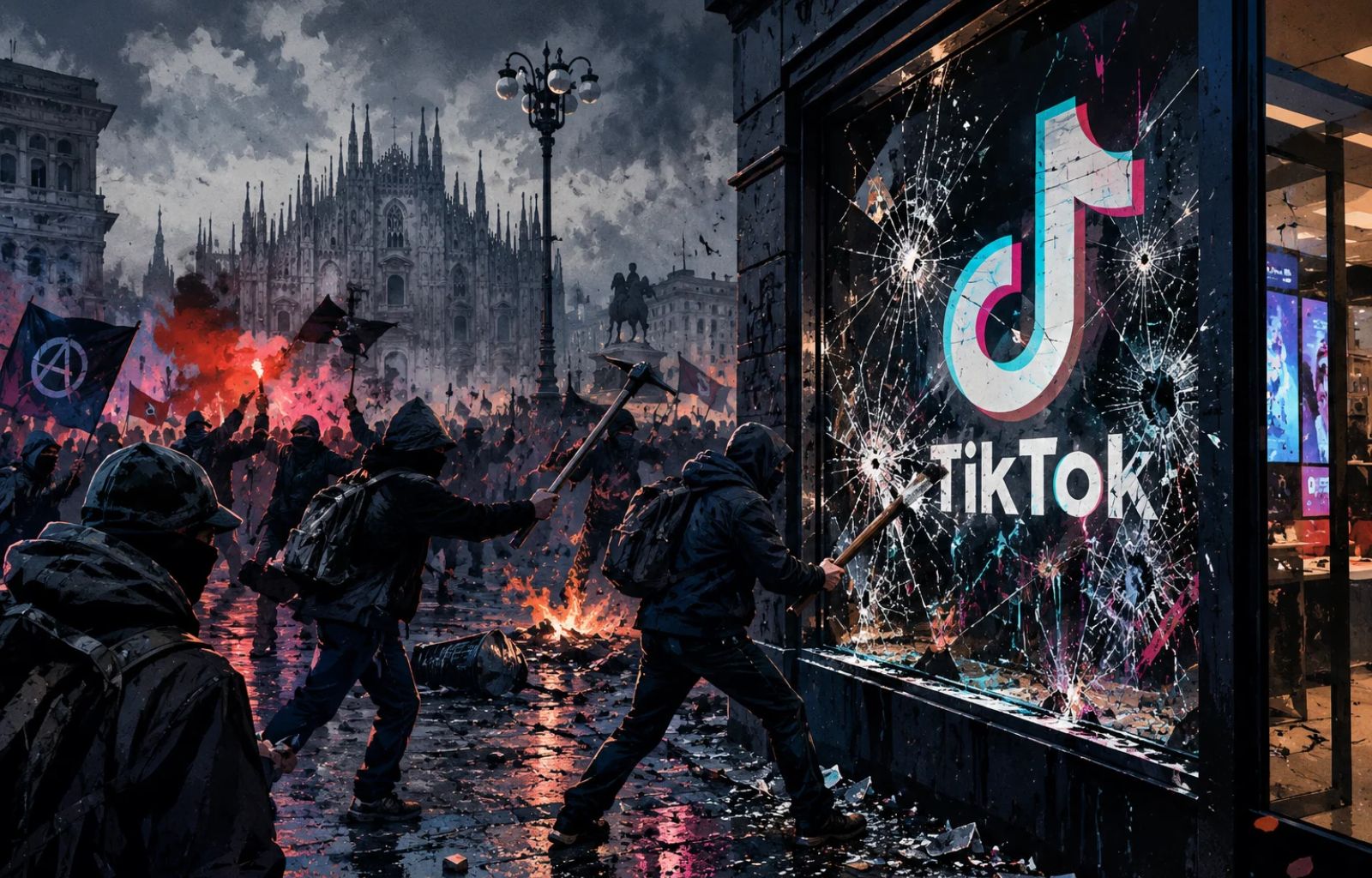
The riots in Milan on 17 October 2026 brought TikTok back into the spotlight of the Italian media. The 17 October Movement had organised itself on Instagram and Telegram, but its recruitment base was on TikTok: children aged 12, 13, 14 who had seen videos of clashes and looting on their feeds, who had replicated them as one might replicate a challenge, and who had built an instant collective identity around that idea. The mechanism was nothing new.
In Rome, the two teenagers from the ‘minicar gang’ who, between 4 and 5 October, had attacked random passers-by in the Monteverde neighbourhood, explained to the prosecutor the reason behind the attacks with a simplicity that speaks louder than any analysis:‘We saw it being done on TikTok. It’s full of videos showing people shoving random passers-by. Nobody got hurt. We thought it would work the same way for us too.” Even before that, the violent gatherings in Peschiera del Garda had been organised via the same platform.
Every time, following incidents of violence, TikTok has made the headlines for a few days and then disappeared from public debate without anyone really stopping to understand what this platform actually is, why it works in a radically different way from any social media platform that came before it, and why, behind its architecture, there is something that goes far beyond an entertainment app for teenagers.
A distribution system, not a social network
The incorrect description, the one circulating in the media, portrays TikTok as a social media platform featuring short videos – a fast-paced version of Facebook or Instagram. This description obscures its true nature. Facebook and Instagram are built around the social network: you see content from the people you follow, and your connections determine your feed. TikTok has a radically different structure. Its main feed, the ‘For You Page’, does not show what the people you follow post: it shows what the algorithm decides you should see, based on your viewing behaviour. How long you spend on each video, what you watch repeatedly, where you pause, where you scroll past. You don’t need to follow anyone to receive content: the algorithm finds you on its own, even before you know what to look for.
This technical difference has specific anthropological consequences. On Facebook and Instagram, you are the one who builds your network, chooses your sources and shapes your information ecosystem. On TikTok, it is the algorithm that shapes you. The feed does not reflect your interests: it shapes them, directs them and progressively radicalises them towards the content that generates the most engagement – that is, the most emotionally intense, the most extreme and the hardest to look away from. The effect is no different from that of a slot machine: the variability of the content, the unpredictable reward, the short format that eliminates the cost of moving on to the next video. It took Facebook around eight years to reach one billion users. TikTok took four. That rate of penetration is the result of a system engineered to create addiction with a precision that no previous social media platform had ever achieved.
TikTok promotes certain behaviours
The short-form video format is not suited to explaining, arguing or providing context. It is suited to showing, imitating and replicating. The ‘challenge’ is TikTok’s native format: you see something, you replicate it, you share it. The algorithm rewards replicability, not the quality or accountability of the content. TikTok spreads behaviours, not ideas. It reduces the cost of collective coordination to zero. Anyone can rally hundreds of people in a matter of hours without any organisational structure, without identifiable leaders, and without filters. This applies just as much to a dangerous challenge as it does to a violent gathering.
The mechanism is self-perpetuating because the platform rewards emotional intensity. A video of street clashes generates more engagement than a video of a press conference. A fire generates more engagement than a banner. Looting generates more engagement than a peaceful protest. The algorithm has no ideology: it has one objective – to maximise time spent on the platform – and it pursues that objective by systematically rewarding the most extreme content. Applied to a generation of teenagers with an acute need for identity and a sense of belonging, it transforms violence into spectacle, spectacle into emulation, and emulation into news.
The spiral operates without any external control: whoever performs the most extreme act gets the most views; whoever gets the most views becomes a role model for their group; and whoever becomes a role model produces further extreme content to maintain that position. No organiser is needed, no structure is needed, no ideology is needed. All that is needed is an algorithm that rewards radicalism and a generation that has learnt to measure its own worth in terms of views.
Added to this is speed, a factor that no educational or family system is able to keep up with . What used to take days to go viral on Facebook or Instagram becomes a model to be replicated within hours on TikTok. The two teenagers from the Rome minicar gang replicated behaviour they’d seen on TikTok within days of watching it – perhaps even within hours. There is no longer any window of opportunity between inspiration and action in which an adult could intervene, a teacher could ask a question, or a parent could notice something. The window closed before anyone even realised it.
Douyin and TikTok: two algorithms, two user bases
TikTok does not exist in China. The Chinese version of the platform is called Douyin, and is run by the same parent company, ByteDance, using the same short-form video format. Douyin’s algorithm promotes educational content, academic achievements, sporting successes and patriotism. For users under the age of fourteen, only a restricted version is available, which shuts down after forty minutes of use and is inaccessible between 10 pm and 6 am. In 2022, the Chinese government compelled thirty major tech companies, including ByteDance, to hand over their algorithms to the Cyberspace Administration of China, the state body that regulates the internet in the country.
A comparison of the two products from the same manufacturer leads to an uncomfortable but accurate conclusion. China uses Douyin to steer its citizens towards content that strengthens social cohesion and support for the regime. It uses TikTok to do the opposite with Western populations: to promote divisive, emotionally destabilising content that erodes social cohesion and diminishes the critical thinking skills of those who consume it. The difference in treatment between young Chinese people – who are protected, restricted and steered towards educational content – and young Westerners – who are exposed, without filters, to an algorithm optimised for addiction – is no accident. It is a deliberate architectural choice, evidenced by the difference between the two products and by Chinese state oversight of ByteDance’s algorithms.
Chinese film production and European figures
ByteDance is subject to the 2017 Chinese National Security Law, Article 7 of which stipulates that‘all organisations and citizens must support, assist and cooperate with national intelligence efforts in accordance with the law’. This is not merely a theoretical provision: it is a legal obligation that cannot be refused and applies to any Chinese company, including ByteDance, regardless of where it operates in the world. TikTok’s chief European lobbyist has admitted that it would be “extremely difficult” to completely prevent European data from being sent to China.
The practical consequences of this legal framework have been documented by the Irish Data Protection Commission, which acts as the lead supervisory authority for TikTok in the European Union. In May 2025, TikTok was fined €530 million for illegally transferring European users’ data to China, in breach of the GDPR. The most significant finding of the investigation was that, during the proceedings, TikTok had claimed that it did not store European data on Chinese servers. In April 2025, it was forced to admit that some of that data had in fact ended up on servers in China, contrary to its previous statements. The €530 million fine is the third-highest ever imposed for a breach of the GDPR. Over 175 million European users continue to use the platform.
ByteDance also has a representative of the Chinese Communist Party serving as vice-chairman, who wields influence over all product and business lines. In 2024, in the United States, the House of Representatives passed a law requiring ByteDance to sell off TikTok’s US operations within six months or to shut down the app in the country, precisely for these national security reasons. The matter remains unresolved.

Because it’s a weapon
Putting the pieces together, the picture is clear. TikTok is a platform designed to be addictive through an algorithm that rewards the most extreme and divisive content. The company that runs it uses a different algorithm in China, where it protects its own citizens from the destabilising content it exports to the West. It is subject to a law that obliges it to hand over its users’ data to the Chinese government upon request. It lied during a European regulatory investigation into where that data was stored. It has a representative of the Chinese Communist Party on its board of directors.
None of this is a conspiracy theory. It is a description of a tool designed to have specific effects on specific populations, run by a company under the control of a foreign government with strategic interests that run counter to our own. Every time a young boy replicates a violent challenge he has seen on his feed, every time a group of minors organises a looting spree via that platform, every time a Western teenager spends hours consuming content designed to radicalise and destabilise them, that platform functions exactly as it was designed to function.
The question that the Italian media still fail to ask, after every incident of violence linked to TikTok, is this: how long will this go on?