They’re doing it again. And you’ve fallen for it yet again.
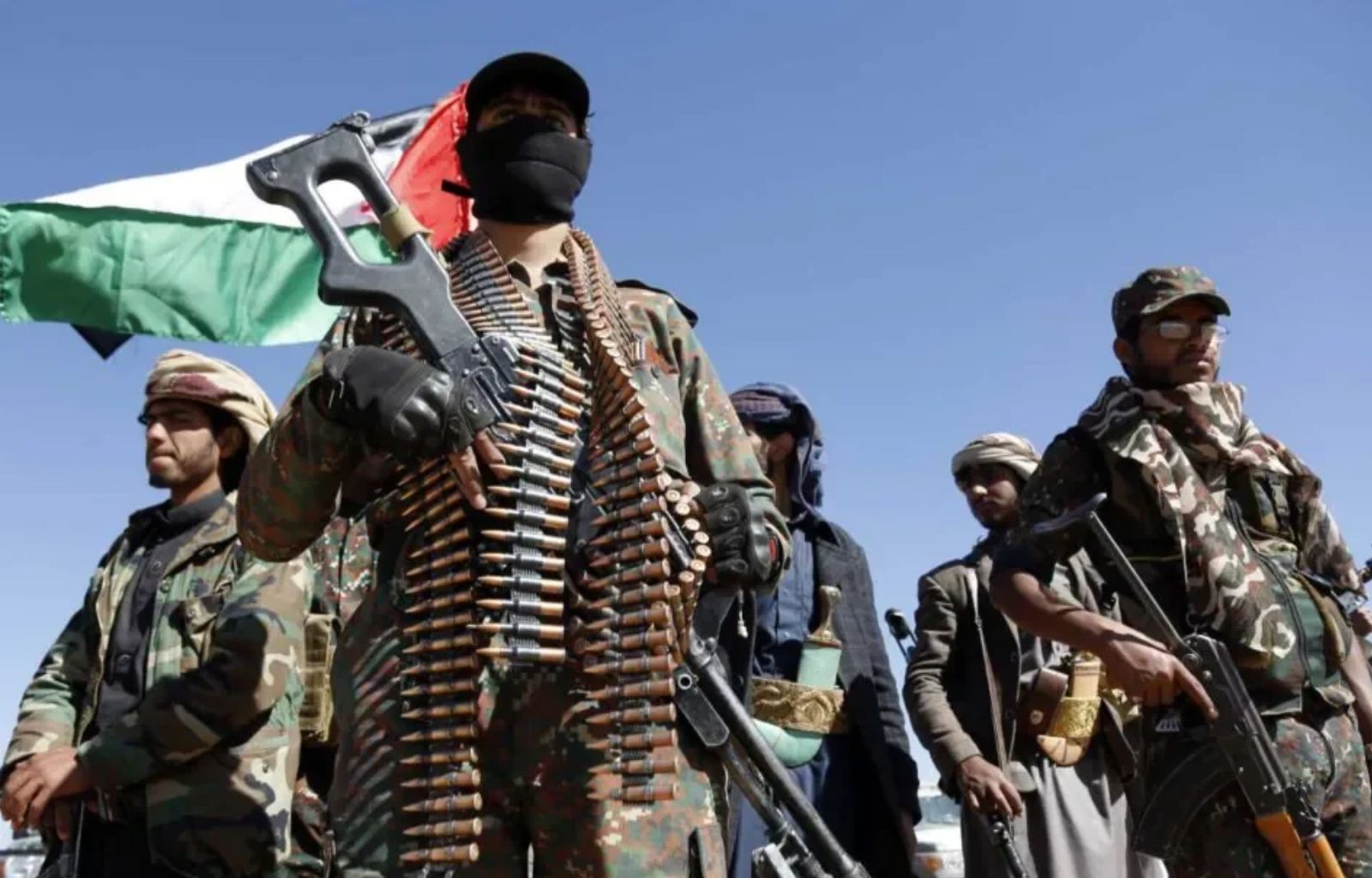
An Italian Eurofighter was hit at the Saudi base in Taif. The following day, Muhammad Mansur, an official at the Ministry of Information of the Houthi government in Sana’a, issued a statement to ANSA that is worth reading carefully: ‘Ours is a legitimate armed resistance in the face of prolonged Saudi aggression. We are not at war with Italy and we do not intend to involve your country. But we do wonder what Italian aircraft are doing in Saudi Arabia in support of Riyadh’s war against us.’
This is not a diplomatic statement. It is a communications strategy precisely tailored to a specific target –Italian public opinion – designed to achieve a specific outcome: to drive a wedge between the people and their government. It is not a message for Crosetto. It is not a message for Meloni. It is a message for Italians. And it works because whoever wrote it knows exactly what we do not know.
The technique: ‘divide and rule’ in communication
On these pages, in October 2025, we analysed Hamas’s communications revolution: the shift from Al-Qaeda’s propaganda of terror to a strategy of engagement, capable of exploiting the West’s internal contradictions rather than attacking it head-on. Hamas did not want to frighten us; it wanted to divide us. The Houthis have learnt that lesson and applied it with even greater precision. This is no coincidence: Hamas and the Houthis are both offshoots of the Iranian ‘Axis of Resistance’, funded, armed and partly trained by Tehran. Strategic communication is part of that package. It is not a spontaneous development; it is a shared doctrine. Iran realised long ago that Western public opinion is as much a theatre of war as the battlefield itself. And it has taught its proxies how to wage war on that front.
Mansur’s statement operates on three simultaneous levels. The first exonerates: ‘We are not at war with Italy’. The second blames the Italian government: ‘What are your aircraft doing in Saudi Arabia?’. The third – the part that is not explicitly stated but which is constructed in the mind of the reader unfamiliar with foreign policy – is: your government has dragged you into a war that has nothing to do with you. It is a communicative wedge, not an emotional appeal. It is designed to raise a question in the public mind – ‘But why are we there?’ – without providing the answer. Because if they knew the answer, they would dismantle the narrative in thirty seconds.
There is no empathy for Italian citizens in Mansur’s words. There is a cold, well-documented awareness that the Italian public is structurally ill-informed about foreign policy, that this lack of knowledge can be exploited, and that a well-calibrated rhetorical question creates internal division far more effectively than any direct threat. The Houthis know us better than we know ourselves. And they prove it every time they open their mouths.

The answer that nobody gives
Forty per cent of Italian maritime traffic passes through the Red Sea and Bab el-Mandeb. One hundred and fifteen billion dollars’ worth of imports and exports every year. Raw materials that power Italian factories, car parts, fuel and wheat all pass through that strait. It is not a Saudi interest that Italy defends out of kindness. It is an Italian interest that Italy defends because, if it does not, no one else will.
The Air-Arabia Task Force – comprising 400 Italian Air Force personnel deployed to Saudi Arabia, Kuwait and Bahrain since the second half of March 2026, along with four Eurofighters, an E-550A surveillance aircraft and anti-drone systems – is there for this very reason. Not for Riyadh. For Bab el-Mandeb. For Italians’ utility bills. For supermarket prices. For the jobs of companies that export to Asia.
If we had left control of those shipping lanes to the Somali pirates in the 2000s, nothing would be passing through there today. If we leave it to the Houthis, it will be Iran that decides when to open and when to close the shipping lanes through which almost a third of everything Italy imports by sea passes. Every country with commercial interests in that route – and Italy has more than almost any other in Europe – has military missions in that area. It is only natural. It is necessary. It is in the national interest in the most literal sense of the term.
The hoax about Parliament not knowing
And then there’s the hoax. The one peddled by certain voices on the centre-left, amplified by a few sympathetic newspapers, and picked up in comments on social media as if it were some sort of revelation: ‘Parliament knew nothing’. It’s false.
Italy has had military missions in that region for decades. This is not something new introduced by the Meloni government; it is not an impromptu decision, nor is it a state secret. It is simply the norm in Italian foreign policy, built up over time by centre-right and centre-left governments, and consolidated through bilateral agreements, NATO missions, European operations and a naval presence in the Red Sea that dates back to the years when no one had even heard of the Houthis. Anyone sitting in Parliament knows that Italy has a permanent military presence in that region.
The Air-Arabia Task Force was disclosed during hearings before the Foreign Affairs and Defence Committees of the Chamber of Deputies and the Senate. Crosetto had informed Parliament by referring to ‘Fact Sheet 4’ on missions in the Middle East. The mission was, and is, published on the Ministry of Defence’s website, accessible to anyone. Tajani clarified that this involved a redeployment of troops from Kuwait to Saudi Arabia. It was no secret. It was on the Ministry of Defence’s website. Anyone who claims that Parliament did not know or did not read the documents is either lying or lying whilst knowing full well that they are lying.
The hoax about ‘Parliament being kept in the dark’ did not arise by chance, but the reasons are far more trivial than they seem: it is run-of-the-mill political opposition, the sort that exploits any confusing situation to attack the government. A few voices on the centre-left are stirring up the usual propaganda fuss. The problem is that doing so on a foreign policy issue with which the public is unfamiliar produces a specific effect: it inadvertently reinforces the very narrative that the Houthis are constructing from the outside. Not through coordination. It stems from ignorance of the context and immediate political expediency. The result, for those on the receiving end, is the same: the suspicion that the government is doing something wrong in a place where we shouldn’t be. And that suspicion, once sown, is difficult to eradicate even when the facts disprove it.
They know us better than we know ourselves
This is the point that should be of greater concern than any attack on a base in Saudi Arabia. Hamas realised this before the Houthis did; the Houthis are applying it with equal precision; and behind both lies an Iranian doctrine that has carefully mapped out the weaknesses in Western public opinion. Italian public opinion is an easy target for propaganda because it is unfamiliar with its own country’s foreign policy.
It is not merely the result of poor-quality information. In an age when any news story can be accessed in a matter of seconds, when sources, analyses and public reports are freely available, choosing not to keep up to date with what is happening abroad is a conscious decision. And as such, it is a fault. To accept at face value the version put forward by those who would like to destroy us, rather than opening a book, reading a report or seeking out a primary source, is even more serious. We are not passive victims of misinformation. We are often willing accomplices in our own ignorance. And those who wish us ill know this, exploit it, and build a strategy around it. The results are evident every day in the comments beneath news articles, in social media shares, and in the rhetorical questions that become accepted as common sense without anyone having verified anything.
There is no empathy towards us in that statement; there is strategy. They know that ignorance about foreign policy turns into mistrust of the government, and they know that mistrust of the government is their greatest ally. They do not respect us enough to explain things to us. They exploit us enough to tailor every word to what we do not know.
The Houthis have addressed the Italians. And the fact that we’re already seeing comments saying ‘exactly, what are we doing there?’ shows that the mechanism works. Just as it worked with Hamas. Just as it will work next time, unless we learn to recognise it.