Rakabuming case rocks Prabowo: Indonesian government shows its first cracks
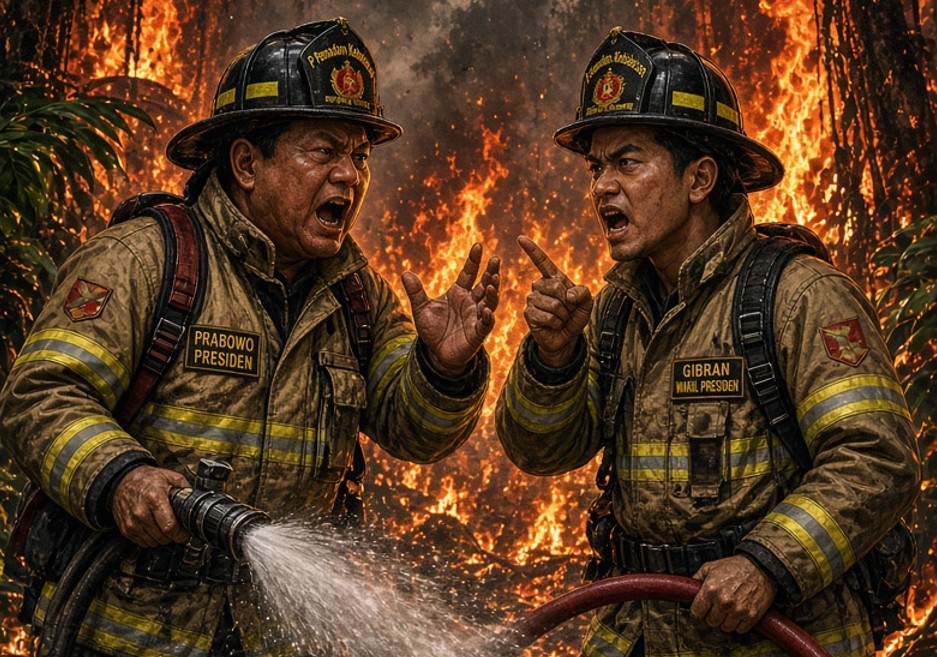
The resignation of Vice-President Gibran Rakabuming Raka comes at a particularly delicate time for Indonesia. Behind the scandal surrounding his academic qualifications lies a political power struggle involving President Prabowo Subianto and his predecessor, Joko Widodo. Meanwhile, amid out-of-control wildfires, protests, economic difficulties and institutional tensions, the government is having to contend with growing discontent that is becoming increasingly difficult to contain.
A vice-president who has become a problem
Indonesian politics is going through one of its most delicate phases since the end of the Jokowi era. On 12 November, Gibran Rakabuming Raka, Vice-President and son of former President Joko Widodo, tendered his resignation to Prabowo Subianto and Parliament. This decision came after weeks of political pressure and a legal dispute over his eligibility to hold the country’s second-highest office.
At the heart of the matter are the educational qualifications of Gibran, aged 39.
Indonesian law requires candidates for the vice-presidency to have completed upper secondary education or hold an equivalent qualification.
Gibran had studied abroad, in Singapore and Australia, relying on a certificate of equivalence issued by the Indonesian authorities. Subsequent court rulings, however, have called into question the validity of the documentation submitted and his ability to demonstrate that he meets the required criteria.
The affair then took on a much more political dimension when, on 11 November, around 120 MPs from eight political groups signed a motion to initiate a process that could have led to his dismissal. Gibran chose to resign before the parliamentary proceedings could continue. Prabowo accepted his decision, publicly thanking him for his work during the first two years of government.
The issue, however, goes far beyond the vice-president’s personal fate.
The alliance with Jokowi loses a member
To fully understand the significance of the resignation, we need to look back at the 2024 elections. Prabowo’s decision to nominate Gibran as his running mate had been one of the most significant political moves of the election campaign. The arrangement allowed the former general to capitalise on the popularity of Joko Widodo, the outgoing president and a figure who remains highly influential in national politics.
The two men had a history that was anything but straightforward. Prabowo had lost the 2014 and 2019 presidential elections to Jokowi, before joining his government as Minister of Defence. The subsequent agreement had brought together two major centres of power, creating a coalition broad enough to secure Prabowo a landslide victory.
Gibran acted as the political link between the two families. His departure therefore risks undermining one of the fundamental elements of the agreement.
As reported by Reuters, the fact that the vice-president has stepped down without particularly strong political backing within the coalition could indicate a significant shift in relations between Prabowo and Jokowi. Jokowi has, however, publicly reaffirmed his support for the current administration, seeking to play down speculation about a definitive rift.
But the question remains open – indeed, very much open. Jokowi retains considerable political influence and could once again play an important role in the run-up to the 2029 elections.
Meanwhile, Gibran’s younger brother, Kaesang Pangarep, is working to strengthen the Indonesian Solidarity Party (PSI), in which the former president could take on a leading role.
Eleven mobile phones and a scandal that is rocking the corridors of power
To make matters even more complicated, another scandal has come to light in recent weeks: the alleged illegal wiretapping scheme said to have involved President Prabowo and numerous Indonesian political figures.
The investigation has brought the name of Listyo Sigit Prabowo, the former head of the national police and considered to be close to Jokowi, to public attention, along with other senior officers. The authorities seized eleven mobile phones, four USB devices and an iPad during the searches. According to the allegations, the wiretaps involved numerous institutional figures, politicians, journalists, activists and businesspeople.
The matter took a particularly serious turn when some government representatives even raised the possibility of an attack on national security and offences amounting to treason. The investigations are still ongoing and individual responsibilities will have to be established.
The case is politically significant because it involves figures linked to one of Prabowo’s main historical allies. There is a risk that a legal dispute could turn into a clash between the two political camps that supported the current president.
It is, in fact, difficult at this stage to completely separate this affair from Gibran’s resignation. Whilst the two issues are distinct, they both point to an increasingly complicated relationship between Prabowo and Jokowi’s inner circle. The Financial Times has described the atmosphere as potentially amounting to open warfare amongst Indonesia’s political elites. For a government that had built its stability precisely on the agreement between these two families, this is far from a reassuring sign.
A country that, meanwhile, is burning
Whilst Jakarta is embroiled in its own power struggles, a significant part of the country is facing an environmental emergency that is now recurring with alarming regularity.
Indonesia is experiencing one of the worst forest fire seasons in recent years. According to a study published on 13 November by the Rainforest Action Network and Nusantara Atlas, as reported by Reuters, around 2.88 million hectares of land were damaged by fire between January and October 2026. The figure for the first three quarters of the year is 35 per cent higher than for the same period in 2019, when the country was experiencing an intense El Niño event.
The weather conditions, characterised by high temperatures and drought, have fuelled the spread of the fires. But it would be simplistic to attribute everything to the climate. The degradation of peatlands, deforestation and the expansion of industrial oil palm and pulp plantations all contribute to creating particularly vulnerable areas.
The study identified thousands of hectares of burnt land within concessions belonging to large industrial groups. It did not establish who actually started the fires, but it highlighted the structural responsibilities relating to land management and fire prevention.
The consequences are severe. Air quality has deteriorated in several provinces, whilst respiratory problems and haze have also affected neighbouring countries. Schools have been closed in some areas, and four volunteer firefighters lost their lives whilst fighting the blazes.
The government’s response has been the subject of fierce criticism. At the end of October, hundreds of protesters took to the streets in Jakarta and other cities, calling on Prabowo to declare a national state of emergency. The government has announced that it has mobilised around 70,000 personnel to tackle the fires, but the protests reflect growing dissatisfaction with the results achieved.
The economy is not on Prabowo’s side
On the economic front, too, the difficulties are becoming more apparent. Indonesia remains one of Asia’s leading emerging economies, but Prabowo’s ambitions are hampered by issues relating to financial sustainability, investor confidence and the ability to actually implement the programmes he has announced.
One of the President’s most ambitious goals is to raise the country’s economic growth to 8 per cent a year. This target is still a long way off, given that GDP grew by 5.29 per cent in the second quarter of 2026.
The greatest cause for concern is the state of the Indonesian rupiah, which on 12 November hit a new all-time low against the dollar, with the exchange rate reaching 18,255 rupiah to the dollar. The financial climate is also being affected by uncertainties surrounding the management of public finances and concerns raised by MSCI, the international provider of financial indices, regarding the transparency of the Indonesian stock market.
The government must also fund particularly costly programmes. These include the scheme to provide free, nutritious meals for schoolchildren, one of Prabowo’s key election pledges. The initiative has reached tens of millions of beneficiaries, but has been marred by incidents of food poisoning and allegations of mismanagement. The resources required to sustain it are fuelling the debate on public spending priorities.
The problem for Prabowo is primarily political rather than economic: fulfilling his election promises requires resources, whilst the financial situation calls for greater caution. This contradiction risks undermining the credibility of the entire presidential programme.
The cracks in a political system
Gibran’s resignation therefore comes at a time when Indonesia’s difficulties have been mounting on several fronts for some time now. The environmental crisis, economic tensions, protests and institutional scandals are testing Prabowo’s ability to maintain control of his coalition.
This does not mean that the president is on the verge of losing power. His parliamentary majority remains substantial, and Jokowi has continued to express his support for the government. It would therefore be premature to speak of a government crisis in the strict sense.
And yet, something has changed. The alliance that had enabled Prabowo to become president is showing significant signs of strain, whilst promises of stability and development are coming up against problems that are increasingly evident in the daily lives of Indonesians.
Gibran could be the first step in a wider political reorganisation. For Prabowo, the challenge in the coming months will be to work out how much of his support actually depended on the coalition he formed with Jokowi and to what extent, on the other hand, he is able to maintain public support on his own.
Indonesia remains a key regional power, but its international influence cannot mask its internal fragilities. And for Prabowo, who came to power promising continuity and growth, the time for concrete action now seems to have arrived. Could this be the beginning of the end for Pak Prabowo?