Europe at different speeds: how important is it to be close to the heart of the market?

The European Union is a single market, but that does not make it a uniform economic area. Significant differences persist between regions and countries in terms of productivity, the ability to attract investment and access to key markets. To understand these differences, it is not enough to look at national borders: geography matters too. Proximity to Europe’s major urban and industrial centres can facilitate access to infrastructure, supply chains and trade flows. The question, then, is to what extent distance from the heart of the European market still affects regions’ development opportunities today.
Economic geography still matters
The increasing digitalisation might lead one to believe that distance has lost its significance. Communicating and exchanging information has become easier and faster, but many activities continue to depend on physical proximity: transporting goods, coordinating supply chains, reaching customers and suppliers, or connecting to key logistics hubs still entails costs.
It is on a similar insight that gravitational models applied to trade and economic interactions in space are based. Put simply, larger economies tend to attract more trade, whilst distance tends to reduce it. This relationship, reconstructed by Capoani (2024) in the context of international trade, can also be interpreted beyond individual bilateral relationships. The concept of a trade gravitational field, developed by Capoani (2023), allows us to consider the attraction exerted by multiple countries simultaneously and to represent the trade forces acting within a market spatially.
Distance, however, is not measured solely in kilometres. Even within the single market, reaching the main European markets can take very different amounts of time and incur very different costs from one region to another. The quality of transport links therefore becomes a decisive factor: Freiria, Sousa and Calvo-Poyo (2022) show how, in various European regions, better accessibility can be linked to more favourable economic performance.
The centre and the periphery in the European market: beyond national classifications
This perspective helps to explain why not all European regions participate in the single market from the same position. A region situated close to major centres of demand and with good transport links can more easily reach markets, suppliers and investment opportunities. Peripheral regions, on the other hand, face higher costs and longer lead times when accessing these.
Geographical location, however, is not enough to explain a region’s development. The quality of institutions, the efficiency of the labour market, technological capacity and productive specialisation can either reinforce or mitigate the effects of distance. It is no coincidence that the European Commission’s Regional Competitiveness Index assesses regional competitiveness across a range of factors, from human capital to infrastructure, and from market size to innovation.
Looking at regions therefore allows us to identify differences that national classifications tend to conceal. During the years of the sovereign debt crisis, the acronym ‘PIGS’ – now a subject of debate and often considered inappropriate – became widespread, used to refer to Portugal, Italy, Greece and Spain. It is interesting to note that these four countries also occupy a relatively peripheral position in relation to the economic centre of gravity of the European Union and the eurozone, albeit with significant differences amongst them.
Madrid, Catalonia and the Basque Country, for example, are particularly competitive regions in Spain, whilst in Portugal the Lisbon metropolitan area stands out. Italy perhaps offers the clearest example of just how misleading national averages can be. In 2022, the European Commission’s Regional Competitiveness Index ranked Lombardy slightly above the EU average – set at 100 – with a score of 103.2, whilst Calabria recorded 58.8. More generally, the Commission itself emphasises that, in many cases, differences in GDP per capita between regions within the same country can be comparable to those observed between different countries. National averages, therefore, tell only part of the story.

Blue Banana and the new balance of European competitiveness
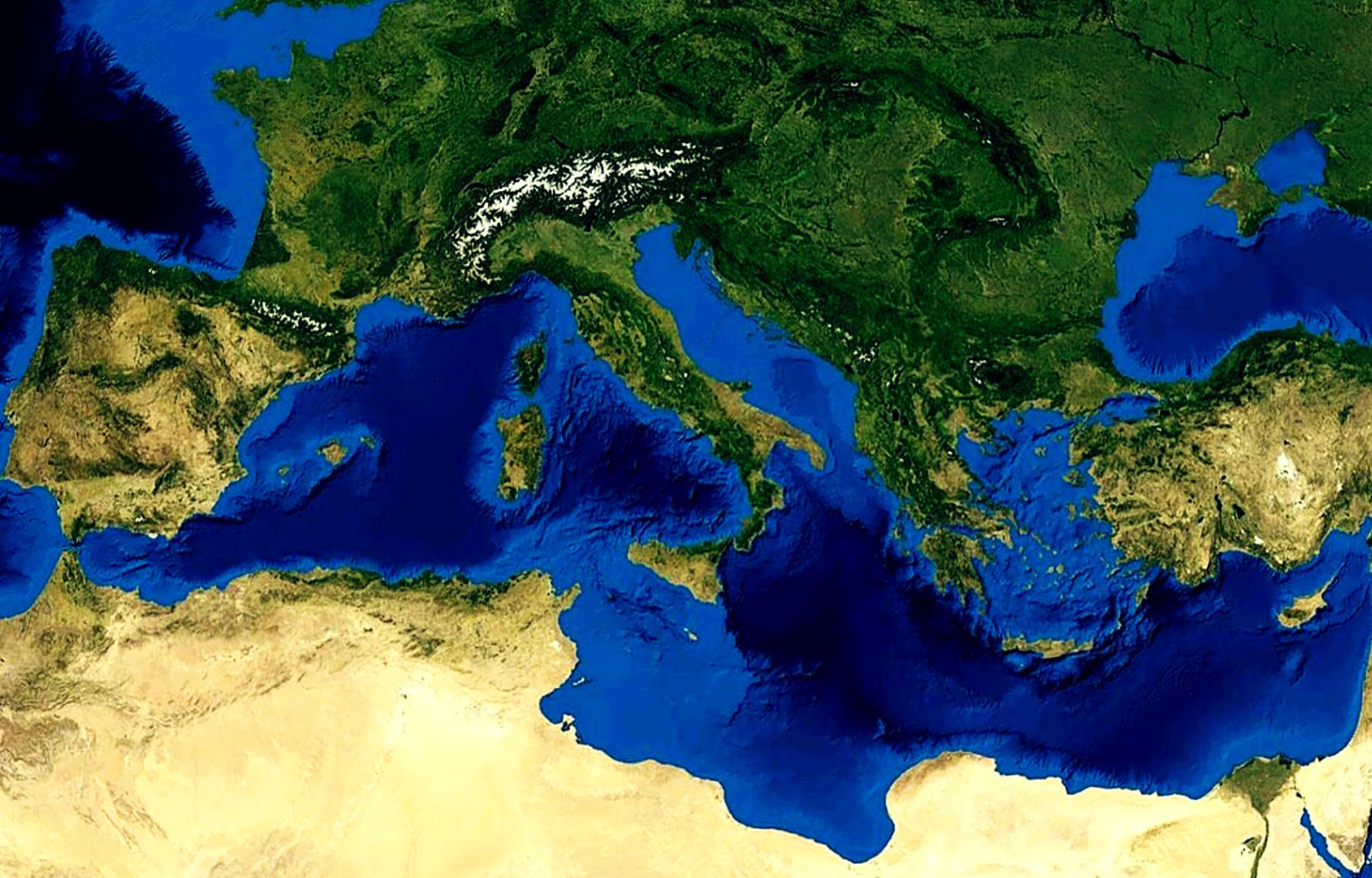
For a long time, the economic geography of the continent has been described using the image of the so-called ‘Blue Banana’: the vast urban and industrial corridor encompassing the Benelux countries, the Rhine region and other parts of Central Europe, extending as far as northern Italy. A significant proportion of the continent’s population, businesses, infrastructure and productive activities has been concentrated in this belt.
For a long time, this view has characterised one of Europe’s main economic hubs. Today, however, it is no longer sufficient, on its own, to explain the competitive dynamics of the continent.
A recent study by the European Youth Think Tank (Capoani and Lakócai, 2026) shows that some regions in the traditional core maintain a strong competitive position, whilst several regions in Central and Eastern Europe, particularly those around the capital cities, have narrowed part of the gap. A similar trend is evident in the European Commission’s Ninth Report on Economic, Social and Territorial Cohesion: per capita GDP in Central and Eastern Europe rose from 52 per cent of the EU average in 2004 to almost 80 per cent in 2021.
The Nordic regions, too, illustrate the limitations of an analysis based solely on geographical centrality. Although they are far from the continent’s traditional economic centre, several of them enjoy above-average levels of competitiveness. In these regions, efficient infrastructure, digitalisation, human capital, innovative capacity and the quality of institutions help to mitigate, at least in part, the impact of distance.
A multi-speed Europe
Talking about a ‘multi-speed’ Europe therefore means looking not only at the differences between countries, but also at the position of individual regions within the European market. The point is not simply to determine which territories are more or less central, but to understand the extent to which their location continues to affect their prospects for development within the single market. The question, then, is to what extent European policies can mitigate the constraints linked to geographical location and prevent peripheral status from becoming a permanent disadvantage.
The single market has reduced many of the barriers between European economies, but it has not eliminated the costs associated with distance. The challenge for the Union is therefore to make this distance increasingly surmountable, by strengthening rail and port links, energy and digital networks, connections between cities, and investment in research and innovation. If Europe wishes to boost its overall competitiveness, it is not enough simply to strengthen its centre: steps must be taken to ensure that the peripheries can also reach it more easily.
Authors
Luigi Capoani is an economist, researcher and lecturer in International Economics at Ca’ Foscari University of Venice. He is the founder and president of the European Youth Think Tank (EYTT), an independent, not-for-profit platform that brings together young European researchers and promotes interdisciplinary research and international collaboration. He also works with Engel & Völkers Treviso in the property sector, combining his academic background in economics with first-hand experience of the Italian property market.
Chiara Moriconi is an analyst at the European Youth Think Tank (EYTT). Her research interests focus on financial markets, systemic risk and financial stability, with a particular emphasis on risk transmission mechanisms and the dynamics that influence the resilience of the economic system.