The ‘Axis of Flags’ in Italy
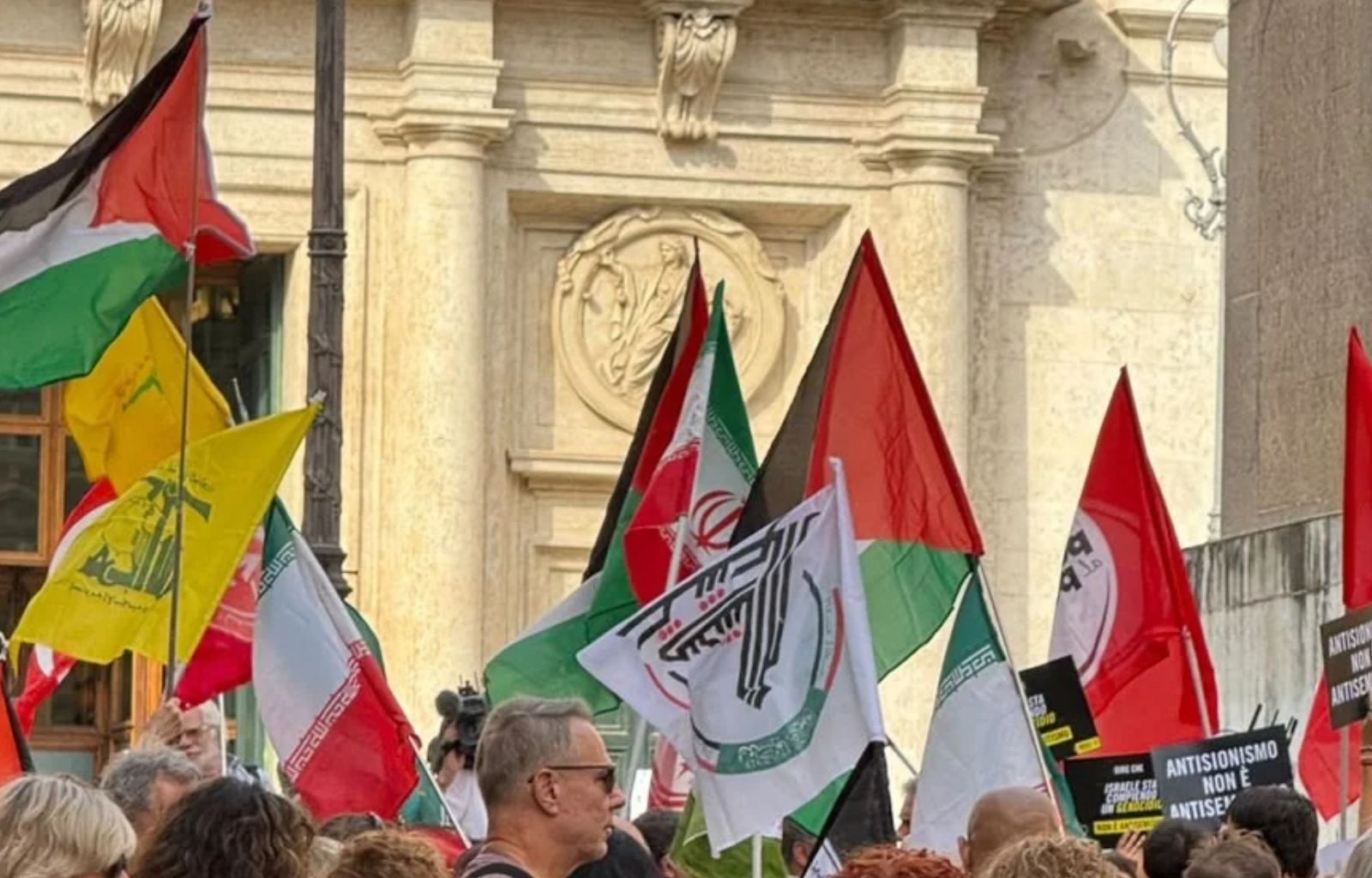
On 2 October, whilst the Chamber of Deputies was debating the bill on anti-Semitism, the demonstration organised to stop it displayed the symbols of Hezbollah, Hamas, Palestinian Islamic Jihad, the Popular Front for the Liberation of Palestine and the Islamic Republic of Iran.
Coincidences can sometimes be instructive. A crowd gathered in a square to argue that the line between criticism of Israel and anti-Semitism does not exist, or is too dangerous to draw, chose to display the symbols of those who have crossed that line with bloodshed. The flags of the al-Qassam Brigades, Hezbollah and Islamic Jihad are not symbols of political dissent: they are the banners of organisations that have madethe killing of Jews a declared objective. The Iranian tricolour in that square does not represent a people: it represents a regime that denies the Holocaust and funds those who translate that doctrine into massacres. The chant ‘Long live Hamas, Hezbollah, eternal glory to Nasrallah’, with its explicit call for the bombing of Tel Aviv, was neither a protest slogan nor an imitation of ‘Tony from Milan’. It was a declaration of intent.
That square did not prove that the law was useless. It proved exactly why it is necessary.
A gagging law? The figures tell a different story
The bill adopts the working definition of antisemitism drawn up bythe International Holocaust Remembrance Alliance in 2016. That definition, which the #NoBavaglio Network and over 250 Italian organisations refer to as the ‘gag law’, had been adopted by 1,334 bodies worldwide as of 1 January 2026 : 47 national governments, including 26 of the 27 Member States of the European Union, the European Commission, the European Parliament, the Council of Europe, the United States, the United Kingdom, Canada, Australia, Brazil and dozens of other democratic countries. The only EU Member State not to have adopted it is Orbán’s Hungary.
The European Parliament adopted it by resolution on 1 June 2017. In 2021, the European Commission published a handbook setting out 35 best practices based on that definition. Since then, 25 out of 27 Member States have adopted it to draw up national strategies against antisemitism. When 250 Italian organisations describe it as a gag, they are taking a stance that no democratic Western government shares.
The definition clearly sets out what is not anti-Semitism: criticism of Israeli policies similar to that levelled at any other democratic country. The scope for legitimate criticism remains intact. What it does is draw the line beyond which criticism becomes something else: the denial of Israel’s right to exist, the application to Israel of standards that do not apply to any other state, and the glorification of those who kill Jews in the name of an ideology. As Piero Fassino pointed out, the draft bill ‘contains no provisions that infringe on freedom, nor any criminal provisions, nor any penalties’. Those who continue to claim the opposite are not defending freedom of criticism. They are engaging in demagoguery by exploiting anti-Semitism, using the fear of being silenced to mask their own difficulty in drawing a distinction that the rest of the democratic world has already drawn.
What do those symbols mean?
The symbols on display in the square are not symbols of a general political protest. On 7 October 2023, the Ezzedin al-Qassam Brigades carried out the massacre at the kibbutzim and the Nova festival: 1,200 dead, documented cases of rape, and children burnt alive. Article 7 of Hamas’s 1988 founding charter quotes a saying to the effect that the Day of Judgement will not come until Muslims fight the Jews and kill them. The 2017 political document softened the wording without repealing it. Hezbollah has for decades carried out systematic missile attacks against Israeli territory. Palestinian Islamic Jihad is classified as a terrorist organisation by the European Union and most Western countries. The PFLP has been on the EU’s list of terrorist organisations since 2001. Behind many of these organisations lies Iran, which for decades has denied Israel’s right to exist and has been funding, arming and training those who translate that denial into war.
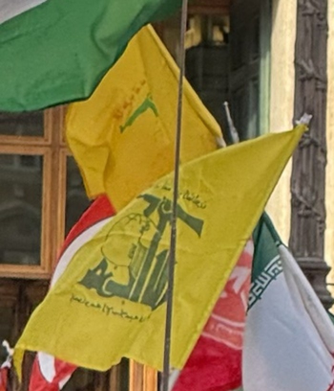
Waving those symbols in the streets is not a criticism of Israel. It is a celebration of those who kill Jews in the name of that ideology. It is precisely the first example given by the IHRA definition to illustrate antisemitism: the invocation, support or justification of the killing of Jews in the name of a radical ideology or an extremist interpretation of religion. That definition was presented to the chamber that was debating it, put forward by those who argued that adopting it was dangerous.
A recurring accident is not an accident
It wasn’t the first time. On 9 September, at the first protest outside Montecitorio, flags of Hezbollah, Hamas and Iran had already appeared, accompanied by chants of ‘Long live Hamas, Hezbollah, eternal glory to Nasrallah’. Among those present were also MPs from the M5S and the PD, who did not distance themselves from the chants and the flags on display – quite the contrary. On 2 October, the symbols reappeared, in greater numbers, and had been extended to include Islamic Jihad and the PFLP. When a recurring incident grows in scale, it ceases to be an incident. It becomes a pattern.
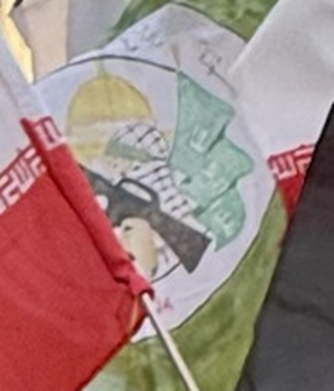
The organisers claimed that there were only a few individuals unconnected to the protest, who had been removed. The figures do not support this version of events: there were far more than five banners, and the organisations represented numbered four plus one state. The ‘infiltrators’ theory does not hold water. Nor does it stand up to logical scrutiny: a coalition of over 250 organisations without a recognised leader has a zero entry barrier. A campaign built to oppose ‘gagging’ cannot impose such restrictions on its own periphery without contradicting itself. It is a structural contradiction, not an isolated incident.
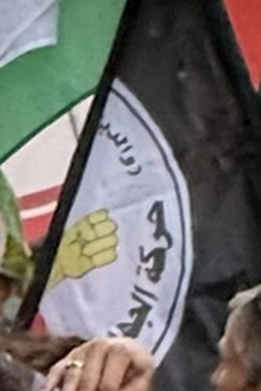
The distancing statement of 2 October echoes that of 9 September, even though nothing has changed in the meantime. Declaring that those symbols have no place in the square, only to find them there in greater numbers three weeks later, undermines the credibility of any subsequent statement.
Who foots the bill for hatred?
The bill will go to a final vote in mid-October. Those in the opposition who chose to take to the streets, or to embrace the ‘gagging’ narrative, must now explain why they endorse an argument that no Western democracy considers valid. Rejecting the IHRA definition in the name of freedom of criticism, whilst those symbols are being waved in the streets, is not a stance of principle. It is complicity with a wave of hatred that is becoming increasingly visible in Italy and facing ever less opposition.
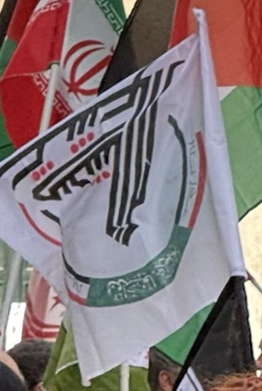
Those symbols are not abstract. The flag of the al-Qassam Brigades represents those who, on 7 October 2023, burnt children, raped women, slaughtered families in the kibbutzim and dragged hostages to Gaza. The Hezbollah flag represents an organisation that has explicitly declared, through the words of its founder Hassan Nasrallah, that the destruction of Israel is a non-negotiable religious and political objective. The chant ‘eternal glory to Nasrallah’ is a hymn to a man who claimed that Jews had gathered in Israel to facilitate their own extermination. The Iranian flag in that square represents a regime that denies the Holocaust, funds those who kill Jews and has enshrined the eradication of Israel in its state doctrine.
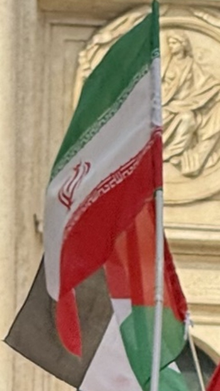
To glorify all this before the Italian Parliament, on the very day that discussions were taking place on how to protect the Jews, is not a protest. It is a display of anti-Semitic hatred in the most explicit form imaginable: the public celebration of those who murder them – and who do not confine themselves to murdering Jews, but anyone who disagrees with their theocratic agenda.
Those who led the rally knew full well. They were aware of the precedent set on 9 September. They organised the rally once again at the place and time of maximum visibility, did nothing to prevent a repeat of the events, and subsequently chose to play down the incident. Those in the opposition who lent their names and their presence to that coalition, knowing what had already happened three weeks earlier, bear a specific political responsibility. Not that of having carried those symbols, but that of having provided the democratic cover under which those symbols found a place.
The strongest arguments in favour of the bill were put forward, protest after protest, by the crowds who wanted to stop it. For Tehran and its allies, this was already a victory – and they achieved it for free.
The editorial team at L’Europeista would like to thankthe UGEI for providing the photographs featured in this article.