That Europe which cannot speak but has much to say

The US National Security Strategy published at the end of 2025 contains a sentence that almost no one in Europe has read with the attention it deserves: the aim of Trump’s United States is to weaken Europe as a geopolitical actor so that it is unable to negotiate with a single voice on trade, technology and security. Trump’s America has a strategic interest in keeping Europe divided. And Europe, with its structural inability to speak with one voice, is actively contributing to its own weakening.
The European paradox in its purest form is this: an entity that has the world’s largest market, a single currency, the most advanced regulatory standards, and a history of integration unprecedented in human history, fails to translate all this into communicative power. Europe has a great deal to say. It knows less and less how to say it. And it has not yet decided who should say it.
Structure before content
By applying the framework of communicative game theory, the European problem can be precisely identified. The theory structures the strategic confrontation across three distinct and interacting levels: the object game, where material resources are deployed; the communicative game, where narrative moves are made; and the metagame, where the interpretative environment within which any message is received is governed.
At the level of the ‘object game’, Europe is a formidable player. At the level of the ‘communicative game’, it produces sound and well-argued positions which come across as fragmented because they are expressed in twenty-seven different ways by twenty-seven national governments, each adapting them to suit their own electoral interests. At the level of the metagame, Europe is virtually absent: it does not govern the interpretative framework within which its messages are received, it does not impose its own interpretative categories, and it does not create the conditions under which its positions can be adopted by third-party actors at little cost.

Structural asymmetry
The players facing off against the EU – Trump, Putin, Xi and Erdogan – are playing a unified game with a single voice and a coherent strategy. The EU is playing twenty-seven games simultaneously, with twenty-seven different voices and twenty-seven partially incompatible strategies. The asymmetry lies not in resources, but in the structure of communication. And structural asymmetries produce systematically unfavourable results, regardless of the quality of the arguments.
As Anu Bradford wrote in *The Brussels Effect* (Oxford University Press, 2020), the EU is already a regulatory superpower that shapes the world in its own image: multinationals comply with European laws – from the GDPR to environmental regulations – in order to gain access to its vast market, and then apply them globally because adapting to different regimes is too costly. When Apple extended GDPR rights to all its users worldwide, it did so not out of ideological conviction, but for the sake of economies of scale. When over 120 countries adopted privacy laws inspired by the GDPR, they did so because European standards have become the global benchmark in the sector.
This is genuine communicative power. But it is exercised unconsciously, through regulation rather than through narrative. Europe is unaware that it possesses this power, or does not know how to articulate it. And power that is not articulated does not generate political legitimacy; in the public perception, it generates bureaucracy.
What does Europe have to say?
The Single Market is the world’s largest integrated economic area, comprising 450 million consumers. The GDPR has become the global standard for data privacy. Erasmus, which has involved over 13 million students across 33 countries since 1987, has empirically demonstrated that European identity is forged through direct experience: those who have spent a year studying in Barcelona or Warsaw return home knowing what it means to be European in a way that no treaty could ever teach them. Horizon Europe, with a budget of €95.5 billion for the period 2021–2027, funds scientific collaborations between researchers from different countries, producing results that no single country could achieve on its own.
European liberal democracy, with its separation of powers, an independent judiciary and freedom of the press, is the political system that has brought about the longest period of peace in the continent’s history.
Nothing is perfect; everything can be improved. The EU has real flaws and its decision-making processes are often slow. But what it has achieved in seventy years is a legacy that no other political entity in history has produced on the same scale. The problem is not what it has to say. It is that it does not say it.
Erasmus is presented as an educational opportunity, not as the key instrument for building a European identity that it actually is. Horizon is presented as a funding programme, not as proof that united European science achieves more than fragmented national science. The single market as a German or French achievement. Social protection as a Swedish or Italian value. Europe as an autonomous narrative subject does not yet exist in public discourse in a structured and coherent way. And a subject that cannot tell its own story allows others to tell it in its place. In the European context, those who do so are the sovereigntists, the populists and the Eurosceptics of all stripes, who have constructed a narrative about Europe that is far more effective than the one Europe constructs about itself.

A ‘game theory’ for Europe
Communicative game theory structures strategic confrontation across three levels. The object game concerns material resources. The communicative game concerns narrative moves. The meta-game is the level at which the interpretative framework within which any message is received is governed: it is who defines the rules of the confrontation even before the confrontation begins.
The US National Security Strategy, which explicitly aims to keep Europe divided, is not a declaration of war. It is a metagame move: it alters the global interpretative environment so that European positions appear weak and irrelevant even before they are voiced. Europe responds at the level of the communicative game, issuing statements, rather than responding to the metagame by shaping the interpretative environment within which those statements are received.
Yet Europe already, albeit unconsciously, possesses the tools to play the meta-game. The ‘Brussels Effect’ is already a form of governance of the interpretative environment: when European regulations become the global standard, the EU is reshaping the categories within which the debate takes place across the world without having to negotiate on a country-by-country basis. When the GDPR becomes the global benchmark for privacy, the EU is defining the conditions under which the moves of all other actors in that field will be deemed acceptable, even before those moves are made. When Erasmus shapes a generation of Europeans who identify as such, the EU is reshaping the cultural environment within which any future proposal for integration will be received.
The problem is that all this is happening without an explicit and coherent meta-game strategy. The EU is unaware that it is playing the meta-game whilst doing so. Three operational principles stem directly from this realisation.
The first is speaking with one voice. Twenty-seven different voices do not produce twenty-seven messages; they create the perception of a divided and ungovernable entity, thereby altering the interpretative framework to its own disadvantage. Trade policy is the area where the EU already governs the metagame: a single voice, standards that become global. Applying that logic to foreign policy is the minimum requirement for beginning to play the metagame in a conscious manner.
The second is consistency over time. The metagame operates over a timescale of years, not weeks. The EU faces the opposite problem: each rotating presidency changes its communication priorities. Consistency of positions over time is what transforms individual communication victories into lasting changes in the global interpretative framework.
The third is the conscious framing of what it is already doing. The Brussels Effect, Erasmus and Horizon Europe are already meta-game moves carried out unconsciously. Describing them as such, systematically, with a single voice and a coherent narrative, is the minimum requirement for transforming an existing regulatory power into recognisable political legitimacy. An actor who fails to articulate what they do allows others to define, in their stead, the categories within which that power is perceived and assessed.
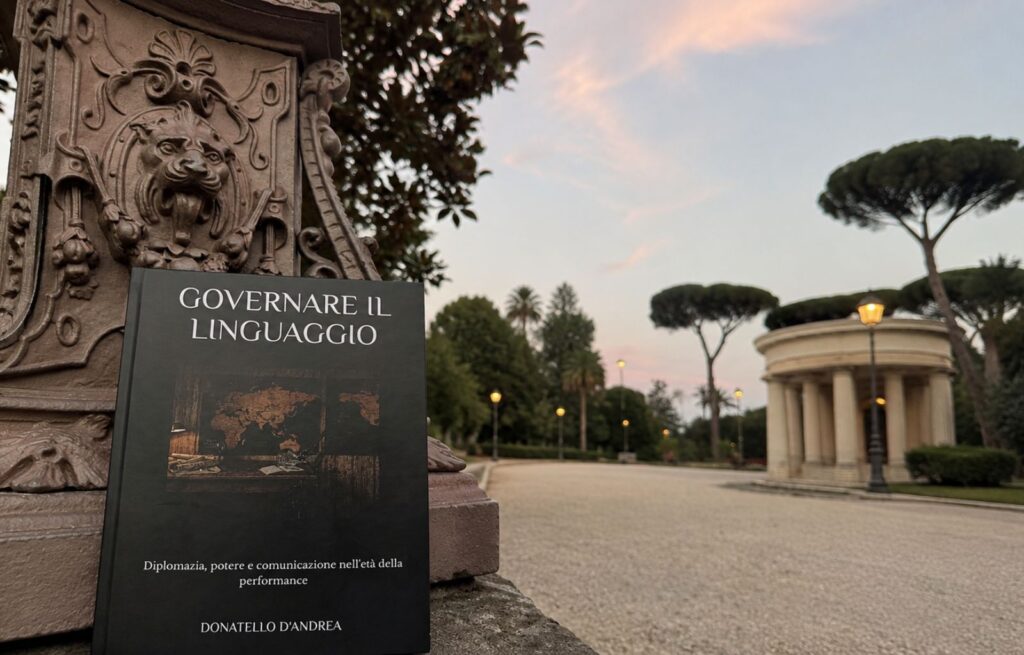
The solution is, first and foremost, a political one
European communication will only improve structurally when the political structure that produces it improves. A European Parliament with genuine powers of legislative initiative and a European government representing its majority would have a recognisable voice, direct democratic legitimacy and a political mandate that goes beyond the intergovernmental level. It would be the storyteller that Europe does not yet have.
In the short term, three measures can be implemented without amending the Treaties: a single spokesperson for each major crisis, with a binding mandate; a shared European narrative produced annually by the European Council and adopted as a reference by all member governments; systematic investment in the development of a European political class capable of crafting messages that are understandable to different audiences without compromising the coherence of the central narrative.
Europe has a lot to say. It already, without realising it, has the tools to play the meta-game. The most effective way to respond to Trump’s National Security Strategy is not a joint statement; it is to build, patiently and methodically, the interpretative framework within which any actor wishing to participate in the global debate is forced to engage with European frameworks. That task requires time, consistency and the political courage to sacrifice national visibility in favour of a unified European presence.
It is a choice. And until that choice is made, Europe will continue to have a lot to say. And yet not know how to say it.