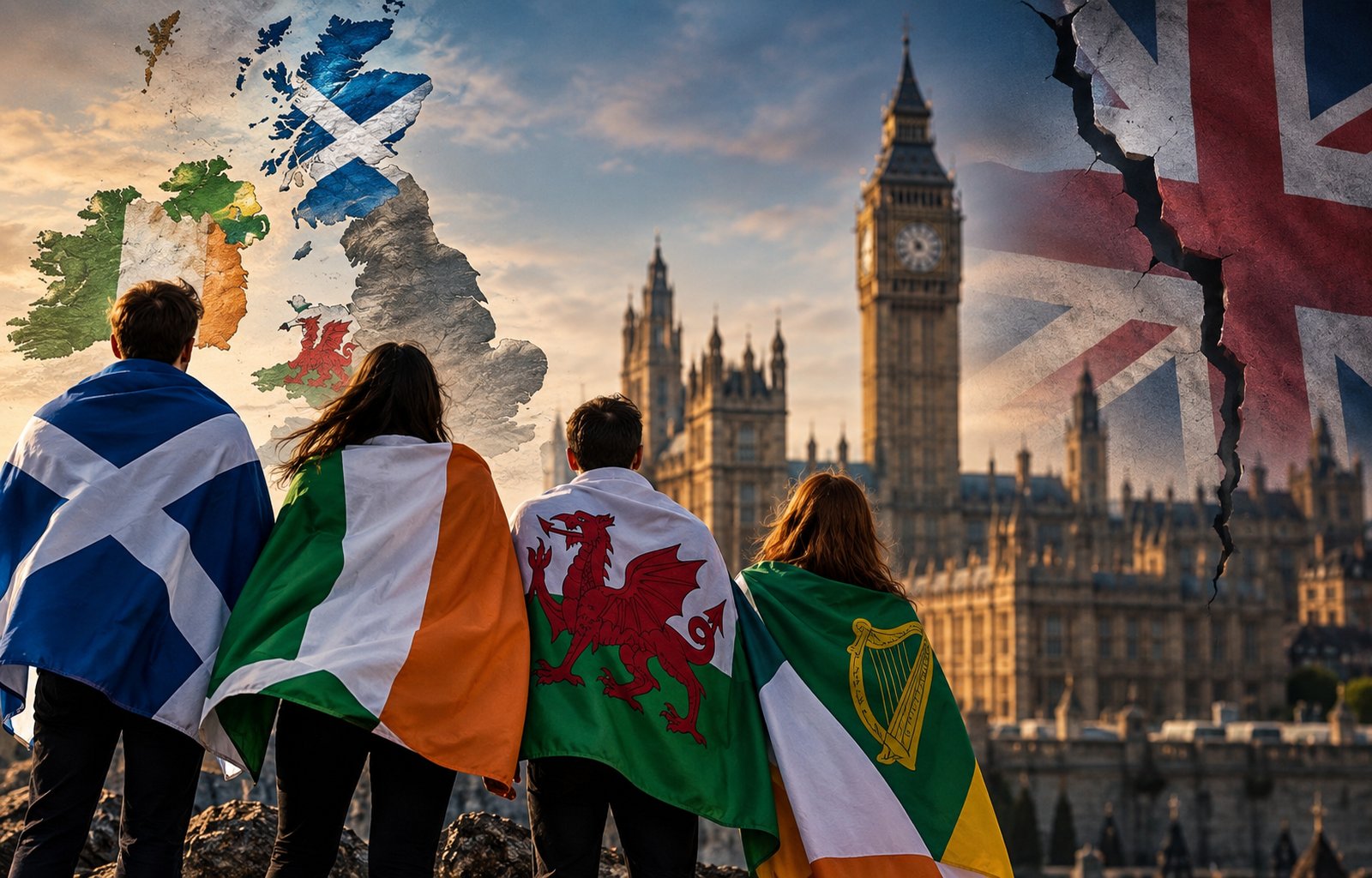
The Prime Minister is just a minor detail: the British crisis goes far beyond Starmer

Starmer has resigned, but his downfall changes nothing: the fault lies deeper within the British system, and no successor can fix it.
A month ago , we wrote that Keir Starmer was losing support at record speed, caught up in the very same pattern that had already devoured his predecessors. On 22 June, that pattern caught up with him too. After just two years, the first Labour Prime Minister following fourteen years of Conservative government announced his resignation, admitting “with good grace” that he was not “the best person” to lead the country, and pledged to remain in office until the party had chosen his successor.
There is only one way to explain his downfall: to stop looking at him.
Papier-mâché
For weeks, the British press had been writing him off, and yesterday Donald Trump took great delight in anticipating his downfall, accusing him of failing to curb immigration. Immigration was, in fact, the only area where Starmer had achieved anything tangible: net immigration has plummeted from over 900,000 in 2022 to just over 200,000 in 2025. The narrative machine churns on regardless of the figures, and once it sinks its teeth into a target, it never lets go. But no campaign, however relentless, can bring down a government that stands on solid foundations. Under Starmer, those foundations had never existed.
The triumph of July 2024 – 411 seats – concealed a flaw visible to anyone who can read the figures: behind the largest majority in recent decades lay a mere 33.7 per cent of the vote – the lowest share with which any party has ever secured a majority in local councils since 1830. A papier-mâché colossus, inflated by the first-past-the-post system far beyond its true weight. All it would take was a breath of fresh air, and sooner or later that breath reaches 10 Downing Street. That 33.7 per cent measures something greater than the weakness of one man: an electorate that no longer allows itself to be confined within the confines of two parties.
The fault line beneath Westminster
For a century, the British system operated on the basis of the divide between capital and labour described by Rokkan and Lipset: two classes, two parties, an electorate that allowed itself to be organised into two blocs. That fault line has closed, and another has opened up: the one pitting open societies against closed societies, which demands not redistribution but identity, boundaries and control. The electoral system, however, has remained the same. The first-past-the-post system, which according to Duverger should narrow competition down to just two forces, really only works where the electorate is already structured. Sartori had warned of this: when old loyalties crumble, that system ceases to simplify and begins to distort.
It had happened before. In November 1922, the Liberal Party – which had been the Kingdom’s natural governing force for half a century – slipped into third place and never recovered, mown down by the very mechanism that had crowned it the moment its electorate split in two. The First Past the Post system shows no mercy to those in power: it punishes those who scatter their votes across the country. Back then, it was just one party that was fracturing. Today, it is two at the same time, with the Conservatives already having evaporated and Labour heading down the same path.
At the root of it all lies Brexit. That referendum did more than simply take London out of the EU: a single, binary vote imposed on a pluralistic society did not simplify it; rather, it opened up a rift within it that has never healed, and this rift has trickled down to the political parties.
The Pincer
Labour, meanwhile, is losing ground on two fronts at the same time. On the right, it is losing ground to Reform, but the most serious haemorrhage is occurring on the left, towards Zack Polanski’s Greens, who have over 180,000 members – enough to overtake the Liberal Democrats and the Conservatives. YouGov polls on the May local elections show a Labour coalition that is fracturing more towards radical environmentalism than towards Farage. The demand for security is drifting away on one side, post-materialist radicalism on the other, and a single party cannot chase after both without splitting down the middle.
The favourite to succeed him is Andy Burnham, Mayor of Greater Manchester, perhaps the last leader with a grassroots following in the North – a base that has now all but vanished from the party’s upper echelons. Yet in January, the party’s NEC blocked his path, rejecting his candidacy for a by-election. Yesterday – and the timing is no coincidence – Burnham was declared the MP for the Makerfield constituency, where he was elected in a ‘staged’ by-election designed to ensure he was ready when King Charles called upon him.
More than just lettuce
Whoever inherits that seat inherits the trap, intact. The most likely scenario is an orderly transition: Labour will find its candidate – almost certainly Burnham – and will hold its ground. Certainly longer than Liz Truss, who in 2022 lasted forty-four days – just long enough for a mini-budget and a live broadcast in which a head of lettuce outlasted her. Burnham will be spared that trigger, and he’ll last longer than the lettuce. But holding on is not the same as governing. He’ll inherit the same illusory majority, the same stranglehold, the same first-past-the-post system that offers him no firm footing.
Since the 2016 referendum, that chair has worn down Cameron, May, Johnson, Truss, Sunak and now Starmer: six prime ministers in less than a decade, with biographies and political affiliations at opposite ends of the spectrum, yet all following the same trajectory. When a chair devours whoever sits in it, continuing to wonder who occupies it is the most subtle way of failing to understand. The fault lies with the chair.
And in the next general election, the prime minister’s seat will almost certainly go to Reform. The polls put Farage’s party at around 27 per cent, eight points ahead of Labour, which is now in second place. The first-past-the-post system will hand Downing Street to them at a time when they are at their least prepared: 1,450 councillors elected in a single round, no leadership cadre, no tried-and-tested governing apparatus. He will take office with the hunger of a victor and the resources of a novice, and that disparity is already inherent in his very rise to power.
The slow spread
For a century, the United Kingdom has exported its model as the gold standard of governance, and half of Europe has looked upon it with envy. Today, that very same model teaches the opposite of what it promised: no electoral engineering can hold together a society that is already divided at its very core. When the electoral machinery ceases to reflect the fabric of society, it no longer produces majorities; instead, it produces governments lacking legitimacy or paralysis in the absence of government. The rift that has brought Westminster to a standstill – that between an open society and a closed one – is already at work across the continent, where, for the time being, proportional representation absorbs it into fragile coalitions rather than allowing it to erupt.
For the first time, the British system no longer has a point of equilibrium: we do not know how it will end because there is no longer a stable state to which it can return. When the world moves faster than they do, machines do not simply give up. They break down.