Motherland’s Debt: remembering and protecting civilian victims, from the former USSR to Italy
From 30 October (Russian) to 4 November (Italian), one question runs through European history: what responsibility does a community bear towards those who have suffered?
On 30 October, Russia commemorates the victims of political repression.
The commemoration, officially established in 1991, builds on the legacy of an act of dissent: on 30 October 1974, a number of prisoners in Soviet camps began a hunger strike in protest against repression and proclaimed it ‘Political Prisoner’s Day’.
Public recognition thus also stemmed from the voices of people whom the authorities had sought to silence.
The day before, on 29 October, the ‘Restitution of Names’ takes place : the reading aloud of the names of people who were deported, imprisoned or killed by the Soviet regime.
The initiative, launched in 2007, continues in 2026 with events and live links from various countries. Its significance is fundamental and profound: restoring a person to memory means rescuing them from the anonymity into which violence sought to confine them.
In contemporary Russia, the calendar continues to mark these commemorations, whilst the independent work of those documenting state crimes is being targeted.
On 9 April 2026, the Supreme Court declared the so-called international Memorial movement to be ‘extremist ’. The Memorial Centre for the Defence of Human Rights denounced the repressive nature of the measure and announced the cessation of its activities on Russian territory.
The memory lives on, however, through family members, academics, campaigners and members of the public.
For 30 October , Yabloko has announced a marathon reading of the names, including online, explaining that bans on public demonstrations have made it necessary to find other forms of participation. Remembering thus becomes an exercise in civic responsibility in the present.
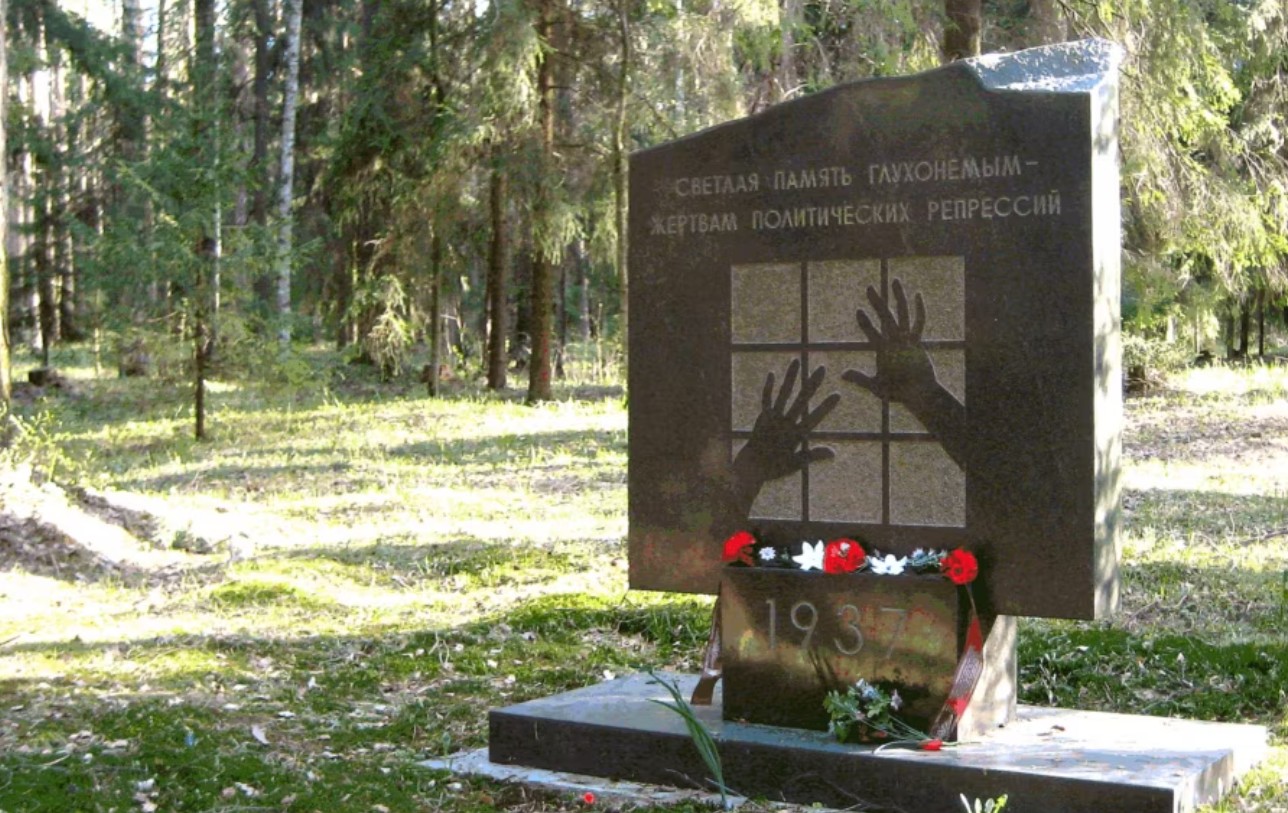
This memory is tied to specific places. In Levašovo, near St Petersburg, an area once used as a secret burial ground by the Soviet political police has become a memorial cemetery.
Photographs, names and marks left by relatives restore a sense of individuality to those buried in the mass graves. In the Moscow area, places such as Kommunarka preserve another chapter of the same history of executions and the concealment of the victims.
The Italian Republic, too, has been involved in this affair.
As Gabriele Nissim recalled, on 18 July 2008, during his state visit to Russia, Giorgio Napolitano met Anatolij Razumov at the Italian consulate in St Petersburg; Razumov was working to recover the names of the victims and preserve the memory of Levašovo.
Nissim had called for a visit to the memorial to the Italian victims of Stalin; the President’s gesture, however, took the form of that meeting. It was a tribute to those who had been forgotten and to those working to restore their history.
The civic significance of that gesture goes beyond the diplomatic occasion. A democratic community also grows when it recognises the victims who challenge the beliefs, allegiances and justifications of previous generations.
A few days after 30 October, Italy celebrates 4 November, National Unity and Armed Forces Day.
Between these two commemorations, which differ in origin and significance, a common question arises: what obligation does the nation have towards those who have suffered?
The story of civilian war victims allows us to address the issue through real-life experiences: those who lost a parent in a bombing raid, those who were maimed by an unexploded ordnance, and those who have cared for an injured family member for decades.
And the women who have suffered violence, only to face obstacles in having the impact of that violence on their lives recognised.
The Italian Republic inherited existing legislation. Lieutenant-Governor’s Decree No. 239 of February 1919 and Consolidated Act No. 426 of the following March provided for pensions for civilians disabled as a result of the war and for certain relatives of those who had died.
In 1940, Act No. 1196 amended the provisions on pensions for civilians injured in accidents. This protection therefore had precedents dating back to before the republican era, subject to specific conditions and limitations.
The Soviet Union, too, provided benefits for certain categories of civilians affected by the conflict. A 1943 decree covered local air-defence personnel and workers at hospitals in Leningrad that had been damaged by enemy action.
In 1956, the pension regulations provided for certain categories of workers who had become disabled in wartime to be treated on a par with military personnel, in accordance with special provisions.
The mere existence of a financial benefit, taken in isolation, therefore says little about the relationship between the individual and those in power. What matters are the conditions of access, the exclusions, the way the authorities operate, and the possibility of challenging their decisions. The democratic nature of a safeguard is also reflected in the freedom to organise, to seek representation, and to ask for an explanation for a refusal.
In Italy, this history is intertwined with thatof the National Association of Civilian War Victims. It was founded on 26 March 1943 under a name referring to civilians killed, maimed or disabled ‘as a result of enemy bombing’. It was established as a non-profit organisation in 1947 and acquired legal personality under public law in 1956. Its history spans the war, the fall of fascism and the establishment of the Republic.
The original reference to enemy bombing is significant: the suffering of the people was described using the political language of the ongoing war. The post-war period forced people to come to terms with lives marked by occupation, bombing, massacres, violence and explosions that occurred after the end of hostilities.
The role of the association gained significance within the gap between a family and a government department: a gap made up of information, documents, money and time.
Understanding which certificate is required, to whom to submit an application, and how to respond to a refusal can determine whether one is able to receive a benefit at all. Through these steps, those in distress find the means to make their voices heard.
Fabio De Ninno, in his article ‘Italian civilian victims of war: assistance, legislation and war pensions from Fascism to the Republic’, highlighted the continuities that hindered access to protection and the role of individual legal battles. Filippo Masina, in ‘Assistance to civilian war victims in Italy (1945–1971)’, linked material needs, legislation and public administration. The Republic also takes shape through care, support and reintegration: areas in which political affiliation becomes part of everyday life.
The Constitution provides a new foundation for this matter. Article 2 recognises inviolable rights and requires the fulfilment of duties of solidarity; Article 3 entrusts the Republic with the task of removing obstacles to freedom and equality; Article 38 establishes rights to social assistance and protection. The rejection of war set out in Article 11 forms part of this framework, alongside the defence of the homeland and the democratic spirit of the Armed Forces as set out in Article 52. Pension regulations are governed by specific legislation, whilst these principles enable us to examine their foundations and limits.
This was followed by the reform of 1950, that of 1968 and the consolidated act of 1978. The latter defined pensions, allowances and war compensation as ‘an act of reparation, due recognition and solidarity’. This formulation combined a loss suffered, a recognition that was due and a collective responsibility.
The term ‘compensation’ requires precision. No sum of money can bring back a parent, a limb or the years spent in suffering. Legally speaking, the war pension is by its very nature compensatory, as clarified by the Constitutional Court in Judgment No. 288 of 1995. Its amount depends on legislative decisions and the balance between solidarity and available resources.
However, a benefit can enable someone to receive treatment, work, study or support a family. It can also convey the message that a loss affects others too. Society shoulders part of the burden that would otherwise fall entirely on the individual and their family.
The time it takes to secure recognition can be extremely long. A case examined by the Constitutional Court in 1987 illustrates this particularly clearly. A woman had been sexually assaulted in May 1944 by foreign soldiers. She had been granted a temporary allowance, but a subsequent application for an increase was rejected following a medical assessment. The appeal was referred to the Court of Auditors and then to the Constitutional Court.
In Judgment No. 561, the Court ruled that provisions which did not provide for pension protection for damages – including non-pecuniary damages – resulting from sexual violence committed during acts of war were unlawful. The decisive basis for this was Article 2: sexual freedom is an inviolable right. The violation of dignity required recognition even beyond the consequences taken into account by traditional classifications of disability.
Forty-three years had passed between the assault and that decision.
Principles that had already been proclaimed had required decades, controversy and individual initiative to alter the practical scope of protection. The distinction between principle, application and experience runs through this entire story. A favourable decision can coexist with years of precariousness. A benefit can take on different meanings for those who receive it and for the institution that provides it.
Diaries, letters and family memoirs convey the lasting nature of the consequences: the work of care, financial dependence, the waiting, and the struggle to start afresh.
It is here that the stories of the victims bring us face to face with one of the great lessons of the twentieth century: no one can appropriate the suffering of others to justify or refute a particular world view.
Pain belongs first and foremost to those who have suffered: in the concrete context of their experience, in the suffering they have endured, and in their assessment of its meaning. The person who has been wounded has a priority to speak which politics, philosophy and historical reconstruction must respect. Their life cannot be reduced to evidence to be presented in support of a doctrine, a nation or an interpretation of history.
When this happens, others assume the power to determine what purpose that suffering was meant to serve. Pain is transformed into a necessity, a price to be paid, an inevitable step towards a truth that has already been decided. The establishment of crimes and accountability, on the other hand, draws its strength from respect for the individuality of the victims.
The same limitation applies to intergenerational relations. No one can treat the suffering of those who lived before us as if it were an investment in the happiness of their descendants. The prospect of future harmony does not retroactively compensate those who have been humiliated, raped or killed. The promise of a better world does not confer the right to declare that suffering necessary.
There can be no future harmony without memory. A peace built on the erasure of victims would harbour within it the very injustice it claims to overcome. To remember is to recognise that every life had its own value, which cannot be reduced to the utility that others may attribute to it.
This issue directly concerns contemporary Europe. Russia’s war of aggression against Ukraine has brought destruction and suffering back to the heart of the continent, for which an international system of redress is being established.
The Register of Damages, established in 2023 under the Council of Europe, collects claims and evidence, laying the groundwork for a subsequent assessment without directly awarding sums or ordering payments.
On 26 October, the agreements with Mariupol also linked information from the municipal war archive to this process: the preservation of memory thus becomes part of the documentation of the victims’ claims.
Progress towards establishing an international commission tasked with examining claims and determining compensation continued in 2026, with the involvement of the European Union.
The gap between documentation, decision-making and actual redress remains a concrete institutional responsibility. A European homeland can also take on substance through these commitments: defending the freedom of societies under attack, protecting civilians, and supporting those living with the consequences of violence.
Cohesion grows when a person can turn to the institutions and find a sense of accountability that endures beyond public sentiment.
The dignity violated by wars and repression has permeated European societies in various forms. A shared sense of belonging requires the ability to acknowledge those wounds whilst preserving the differences between the various events and establishing who was responsible for them. For this reason, Russian citizens who preserve the memory of these acts of repression also form part of Europe’s civic history. Their opposition to the erasure of the victims bears witness to the possibility of a homeland founded on responsibility towards people. The future of Europe must recognise this voice, alongside the Ukrainians’ right to freedom, security and justice.
Reconciliation between peoples requires both of these considerations. Individual suffering can be heard beyond national borders; historical truth must distinguish between acts of aggression, crimes and responsibility.
Any future reconciliation between Russians and Ukrainians will have to grapple with the memory of this war and with the rights of those who endured it.
Between 30 October and 4 November, the meaning of homeland can be examined through this commitment: to be accountable for people, to preserve their names, and to give public expression to the recognition of their dignity. No future happiness justifies forgetting those who have suffered.
A European homeland can become a shared home only to the extent that it is willing to take on this limitation as its own responsibility.