Hamas and the new communication frame of terrorism

From the apocalyptic propaganda of the early 2000s to the communicative sophistication of the digital age, terrorism has always invested in narrative.
But it was with Hamas that a profound strategic caesura took place: the overcoming of Al-Qaeda’s communicative paradigm in favour of a more fluid, mimetic and adaptive narrative grammar.
While Al-Qaeda relied on a vertical, rigid communication, modelled on an ideological-religious framework impervious to the codes of the West, Hamas has chosen a hybrid strategy, capable of speaking as much to the local imagination as to the Western progressive conscience.
Bin Laden’s videos were designed to incite terror; the images of Gaza, relaunched by Hamas, seek to arouse empathy, identification, guilt.
The difference is profound, and is reflected in the management of the crisis, the construction of consensus and the manipulation of Western discursive weaknesses.
If Al-Qaeda attacked the West frontally, Hamas exploits its contradictions: it uses the languages of information, the codes of human rights, the rhetoric of the fight against oppression.
It is a paradigm shift: from terror propaganda to proximity communication.
Hamas has realised that the Palestinian issue, so dense with suffering and symbols, lends itself to a highly emotive narrative, capable of taking root in aWestern public opinion increasingly hostile to Israel, where automatic solidarity with the Palestinian cause often borders on militant anti-Semitism masquerading as humanitarian commitment.
Exploiting this inclination, Hamas has turned its communicative apparatus into a sophisticated system of consensus production. It has constructed the figure of the resistant victim and fuelled (to the tune of billions from the Qatari methane tankers) information bubbles in which selective empathy prevails over analysis.
In this way, the affair ceases to be merely political: it becomes communicative, indeed, algorithmic.
Hamas and the strategic adaptation of communication
Hamas communication, therefore, is no longer just an instrument of recruitment or vindication: it has become a strategic lever in the management of global consensus and political legitimacy, particularly vis-à-vis the West.
Al-Qaeda, although it revolutionised terrorist propaganda in the 1990s and early 2000s, had limited itself to using a religious and anti-Western language, with a closed, symbolic and spectacular message (think of 9/11), which mostly found resonance in radicalised circles.
Hamas and its backers, on the other hand, have chosen a more fluid, adaptable and transversal communication, which insinuates itself into the cultural, linguistic and value codes of our public opinions.
Through platforms such as Telegram, X/Twitter, Instagram and by mobilising networks of digital activists, Hamas has built a multi-layered narrative:
- He talksto the Arabs about resistance and holy war;
- He talksto international observers about human rights, social justice and anti-colonialism.
It is a situational communication, capable of changing tone, register and content depending on the audience: religious and identity-based for the Arab masses, legal and moralising for the West.
This strategy rests on three pillars:
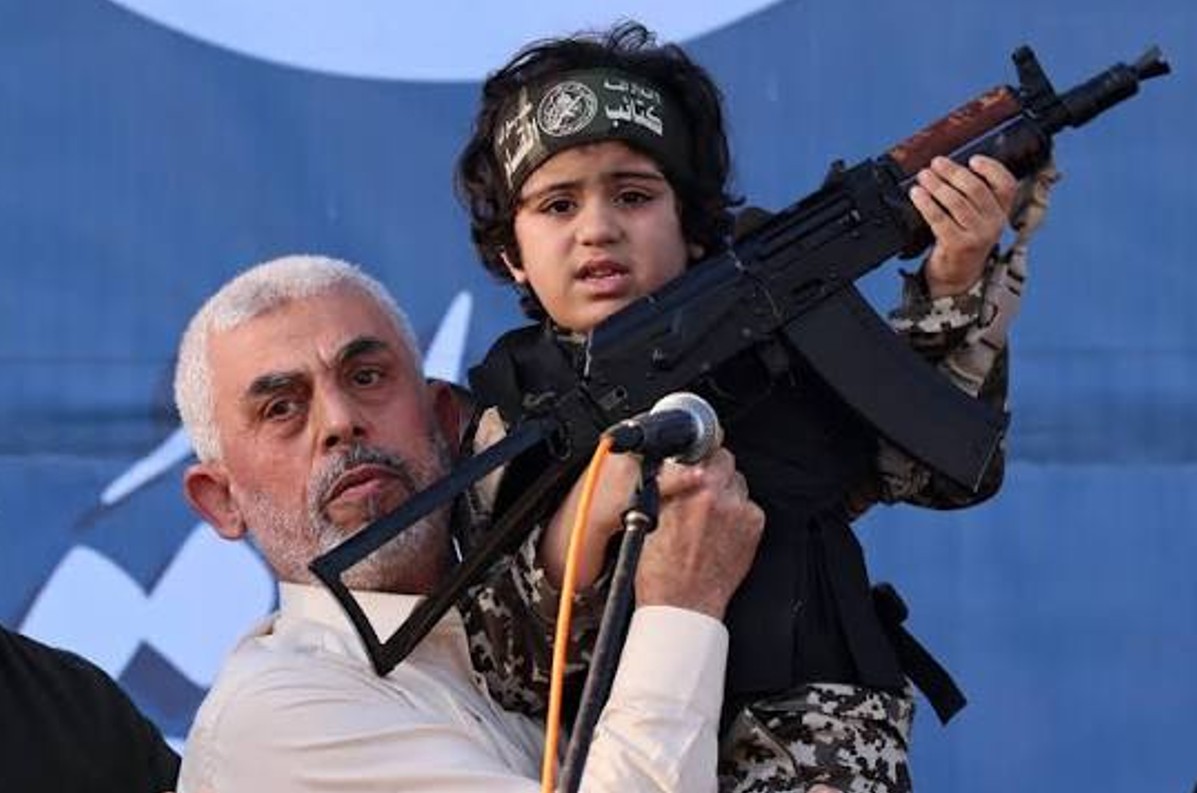
- Strategic victimisation: Hamas presents itself as the victim of systematic aggression, appealing to Western sensibilities for human rights, in particular through images of wounded children, desperate mothers, stricken hospitals. It is a form of ’emotional branding’ of the conflict, aiming to generate instinctive empathy, even before rational understanding of the facts.
- Digital disintermediation: bypassing traditional media, Hamas builds a direct and horizontal relationship with global public opinion. Information is no longer mediated by newspapers, but circulates in the form of videos, memes, photographs, viral testimonies. It is the memetics of war, in which the visual impact surpasses that of content.
- Discursive appropriation: Hamas does not reject Western values, but manipulates them: it speaks of ‘apartheid’, ‘colonialism’, ‘self-determination’, no longer as anti-imperialist slogans, but as universal categories emptied of their original context and reused to gain legitimacy. In this way, those who criticise Hamas risk appearing complicit in oppression, while those who defend it are seduced by the language of justice.
The construction of cognitive bubbles on social media, then, is not a side effect, but part of Hamas’ communicative project. The platforms themselves facilitate the repetition of content akin to each user’s profile, while the ‘pro-Palestinian’ message is continuously reinforced by retweets, shares and endorsements. Thus, those who enter that bubble see only images and stories that reinforce the Movement’s narrative as a sacrosanct victim.
Critical voices – though they exist – do not penetrate: they are filtered, obscured or reduced to silence. It is a process of narrative self-reinforcement, where the platform and the content converge to isolate the audience from the overall vision.
The case of Saleh Aljafarawi, known as ‘Mr Fafo‘, is emblematic. An influencer with millions of followers, he alternated performative roles in videos (grieving father, doctor, victim) with professional ‘journalist’ narratives (all while attracting accusations of embezzling humanitarian funds).
After the rumour of his death was spread in an internal clash between Palestinian factions, he was portrayed in the West and on social media as a ‘journalist killed by Israel’, without any critical analysis or insight.
His case sums up the power of performative forgery in Hamas communication: producing fiction, presenting it as truth and gaining consensus from it.
The seduction of contradictions: between selective empathy and manipulation of guilt
The communicative power of Hamas is thus based on its ability to exploit the internal contradictions of the West.
The Islamist group does not propose a clash of civilisations, but denounces an alleged inconsistency of the West with its own ideals. In this way, moral judgement is shifted: not onto the violence of Hamas, but onto the alleged hypocrisy of Western democracies.
And so, in 2025, Hamas can:
- Publicly executing alleged collaborators in Gaza;
- Repressing rival clans such as the Dughmush (13 and 14 October 2025);
- Seize international aid to finance their own power network (as even the usually very compliant UN has documented);
without the Western media echo exceeding the threshold of episodic denunciation. Why? Because the dominant frame is still that of ‘legitimate resistance’.
However, this strategy is not without risk. The real danger is not the excess of communication, but its extreme simplification. When every crisis, every bombing, every victim is reduced to an emotional symbol without historical, political or strategic context, the Palestinian issue becomes a monochromatic, irreversible icon.
In this scenario, it does not matter who governs in Gaza, what the internal relations are, what the Arab-Israeli alliances are: everything is read through the univocal lens of heroic resistance. This is how any proposal for negotiation, mediation, institutional transition becomes a betrayal.
This is why the greatest risk is not propaganda but the erasure of nuances, the obscuring of reality in favour of a single narrative.
Hamas reinvented terror communication not by focusing on ideology, but on the sensitivity of the other. It sensed the cracks in the West – its obsession with the alleged faults of the past, its selective focus, its emotionality activated on command by algorithms – and turned them into propaganda tools.
But when communication becomes the real arena of conflict, the risk is permanent simplification: reducing Gaza to a symbol, Palestine to a hashtag, resistance to an aesthetic of pain. The media victim replaces the political citizen, and the war is played out not in the field, but in the timeline.
The Palestinian issue, emptied of history and politics, is in danger of becoming just a matter of perception, for the benefit of those who control its dominant frame.
And those who control the dominant frame, at the moment, are not interested in the good of the Palestinians, but only in desperately clinging to power.