The future is already here: a glimpse into the world of autonomous driving
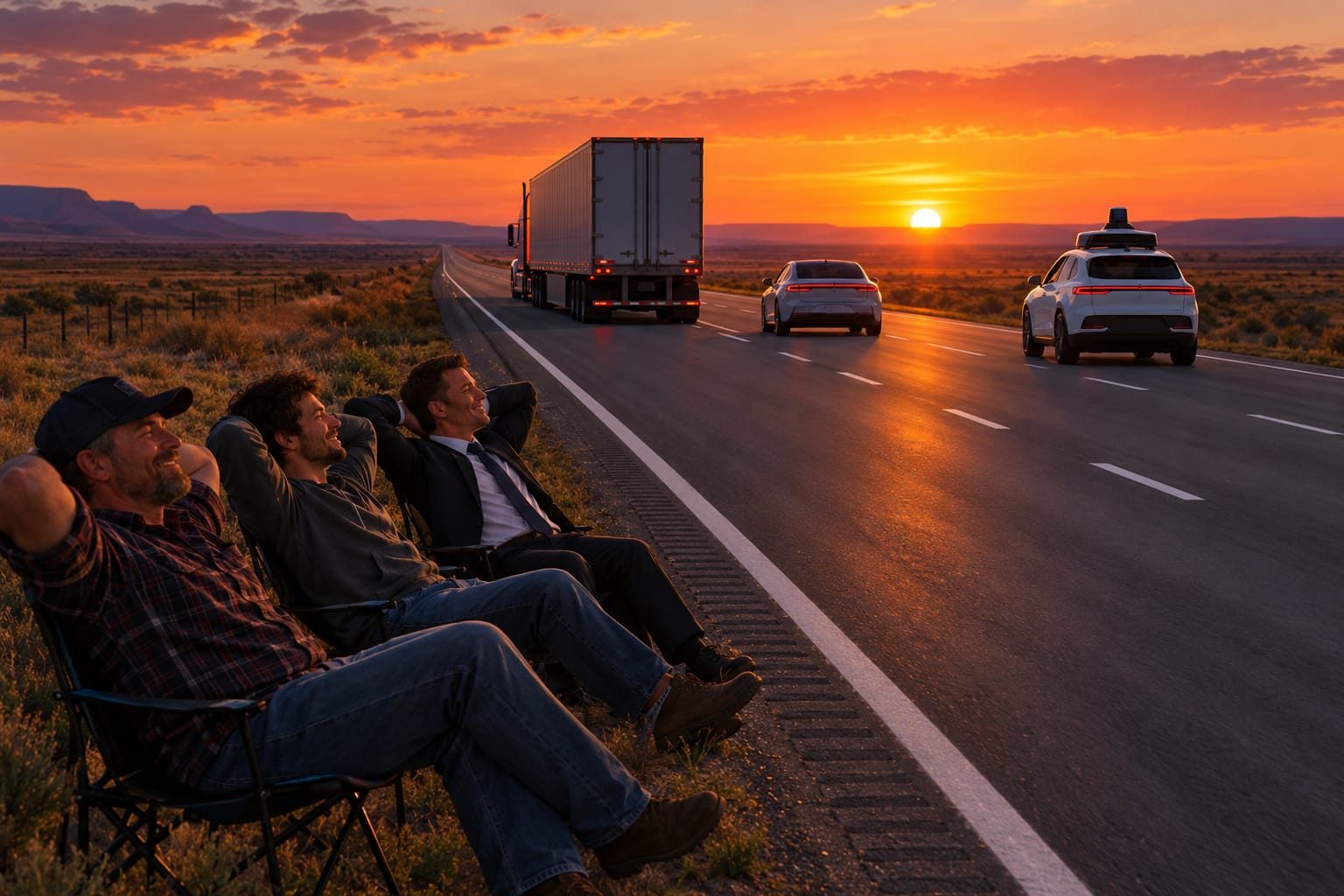
Let’s try to imagine a vehicle (car, lorry, taxi, bus) with no one at the wheel, travelling freely through our cities in complete safety.
Science fiction? Yes, but also a future that isn’t all that far off, thanks to developments in autonomous driving, which we’ll be looking at in this article – but first…
A bit of history
Let’s start with the fact that the correct term would be ‘automated driving’, because ‘autonomous’ implies ‘having a will of its own and operational independence’, but since it has now entered common parlance, we too will go along with it and refer to “autonomous driving”, in the hope that no one will look for free will and consciousness in this technology, just as one does not look for a mane and hooves in a motorised horse.
The story (1) begins in 1925 when the Linrrican Wonder, a driverless car controlled remotely by an operator via radio signals, was tested on the streets of New York.
In 1958, General Motors unveiled the Firebird III, which was fitted with various electronic systems that we still use today: lane-keeping, cruise control and collision-avoidance systems.
We then come to 1986, when engineer Ernst Dickmanns’ VaMoRs was the first prototype of an automated car without remote control. It utilised data from sensors and cameras.
In the 1990s, Mercedes-Benz carried out its first road tests with the VaMP and VITA-2 models, which were the first such trials in Europe.
Italy, too, has played a leading role in this field of experimentation, thanks to Mr Broggi, who, in 1998, organised the ‘Mille miglia in automatico’ using the Argo prototype and is currently the general manager of VisLab in Parma.
Where are we at?
The SAE (Society of Automotive Engineers) classifies autonomous driving into six levels:
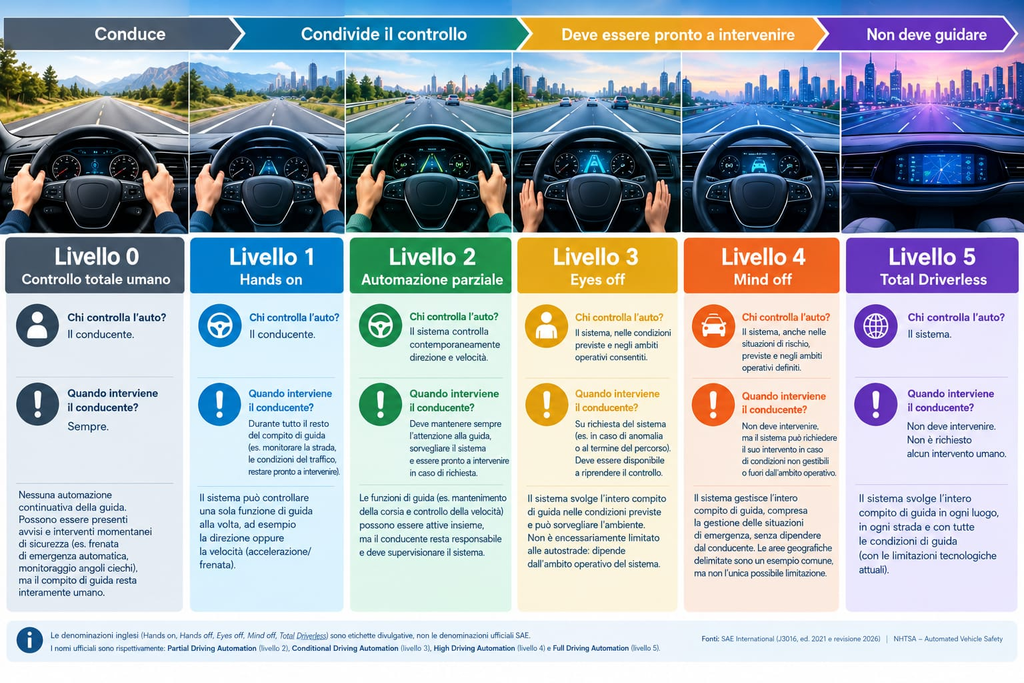
At present, we are at Level 2 in commercial terms, whilst Level 3 – such as Mercedes-Benz’s Drive Pilot (6) – is still a niche product sold only in limited markets and can only be activated in very specific situations.
Level 4 is currently only available as a local transport service, such as robotaxis (2); Level 5 does not yet exist, except in an experimental form.
The roadmap (5) drawn up in 2026 by Luiss Business School indicates that the arrival of fully autonomous driving (SAE Level 5) has been brought forward by 10–15 years, estimating it will take place between 2035 and 2040.
The new frontier in the development of autonomous driving is the so-called ‘end-to-end’ (4) approach – that is, an AI-based system in which, through machine learning, the car ‘learns’ to drive like a human being.
This differs from the traditional method, where programmers use algorithms to define the vehicle’s driving rules.
This new technology has certain limitations, such as: a shortage of talent capable of developing it, the ‘hallucinations’ typical of AI and, above all, the ‘black box’ effect, whereby we know the inputs we provide and the outputs we receive, but do not understand how one leads to the other – in other words, how the AI ‘reasons’.
According to a McKinsey survey based on the forecasts of dozens of industry experts, the future for levels 3 and above will be a hybrid system in which, for example, AI will calculate a trajectory whilst the traditional system will monitor and make decisions.
Safety
Many concerns about this technology centre on safety. The actual figures, based on road tests in real-world conditions, provided by Waymo (7) (which currently operates a Robotaxi(3) service in over 20 cities worldwide and aims to enter the Madrid market in 2027) and by the IIHS (8) ( the Insurance Institute for Highway Safety, an independent, not-for-profit organisation dedicated to road safety) indicate, on the contrary, a drastic reduction in accidents (-68 per cent), particularly those resulting in serious injury or fatalities (-95 per cent).
However, the studies specify that, despite the 271.3 million miles analysed, it is too early to draw definitive conclusions given the scarcity of data (few kilometres, accidents and years) and the limited number of scenarios available; nevertheless, we can say that the initial studies point to a decidedly promising outlook.
Real-life examples: heavy goods transport
Trials of autonomous driving are taking place across all transport sectors: cars, public transport and lorries. Here are a few concrete examples.
As for heavy goods road transport, Hirschbach Motor Lines has purchased 500 self-driving lorries from Aurora Innovation(9), which will cover long-distance routes, leaving the so-called ‘last mile’ to the drivers, where human experience and knowledge still reign supreme; the company promises a saving of $0.16 (from $1.01 to $0.85) per mile, which, for lorries travelling 200 miles a year, amounts to $32,000 per lorry per year.
Another US-based project is being led by Daimler Truck, in collaboration with TORC (10), which aims to bring autonomous lorries to market by 2027 for ‘hub-to-hub’ routes – that is, from one destination to another – thereby leaving the last mile to human drivers in this case too.
Whilst the US may be laughing, China is certainly not crying. In fact, the ‘Space’ lorry (11) by Kargobot was unveiled at the Auto China 2026 motor show; this is a Level 4 autonomous long-distance truck, featuring two major innovations: the first is that it has no cab, thus offering greater load capacity (+25 per cent load volume for the same dimensions, +10% effective payload capacity according to the company); furthermore, the lorries will be electric and it will be possible to ‘refuel’ by replacing the battery in a very short time (3–5 minutes) using robotic arms at dedicated stations, via CATL’s Battery Swap system (12).
As far as Europe is concerned, one of the most interesting projects is undoubtedly Einride ( 13), a Swedish company based in Stockholm which, in collaboration with Lidl, has recently launched the Einride Pod – a 100 per cent electric lorry that operates freely (subject to specific authorisation) on the roads of Germany.
Its main features include a range of 200 km – making it ideal only for short, repeated journeys – the absence of a cab (thereby providing more load space) and the ability to be driven remotely in the event of any issues.
Real-life examples: public transport
We will return to this topic in a dedicated article, but it is worth mentioning Waymo’s robotaxis (14), now a well-established presence with millions of miles under their belt on the roads of Phoenix, San Francisco and some 20 other cities – a trend being followed by Tesla and the Chinese firms Pony.ai and WeRide. (15)
Real-life examples: cars
In the automotive sector, competition is fierce, with a host of rivals including Tesla and Mercedes-Benz, which we have discussed previously, but I would like to focus on two Italian companies (although the second has been taken over by a US firm, Ambarella): Niulinx and VisLab.
VisLab (16), based in Parma, has been a pioneer in autonomous driving, having explored the field as early as 1998 when it was still just a small research laboratory within the University. Thanks to Professor Alberto Broggi, it gained fame and attracted attention through the aforementioned ‘Mille Miglia in automatic mode’, in which the ARGO vehicle, whilst not completing the route, came very close to the finish line.
It became a company in 2009; today it uses technologies such as radar, long- and short-range cameras and topographical maps to detect, track and understand the scene – all based entirely on AI through computer vision and radar – and utilises end-to-end technology for planning and control; it frequently conducts Level 4 road testing.
NiuLinx (17), founded as a spin-off from the AIDA (Artificial Intelligence Driving Autonomous) research project at the Politecnico di Milano, focuses on multimodal public urban transport in which thethe car is just one part of the journey and not the only alternative to transport in the city – particularly in small towns and suburbs where local public transport is rather lacking – has recently signed a memorandum of understanding with the City of Milan and the City of Brescia. Their ‘sharing for caring’ project in Darfo Boario Terme is particularly interesting: ‘an autonomous shuttle for a “robo-caring” service, designed to assist the most vulnerable people with their daily journeys. Technology thus becomes a catalyst for independence and accessibility for everyone”, from which a short film (18) was subsequently produced.
Autonomous driving and the major powers
According to many analysts, the transport system will shift from being based on private cars to a shared system, in which the car will be a form of on-demand public transport organised and managed by public-sector companies – or private companies under strict public control.
Fleets of self-driving cars are, and will be regarded as, strategic infrastructure.
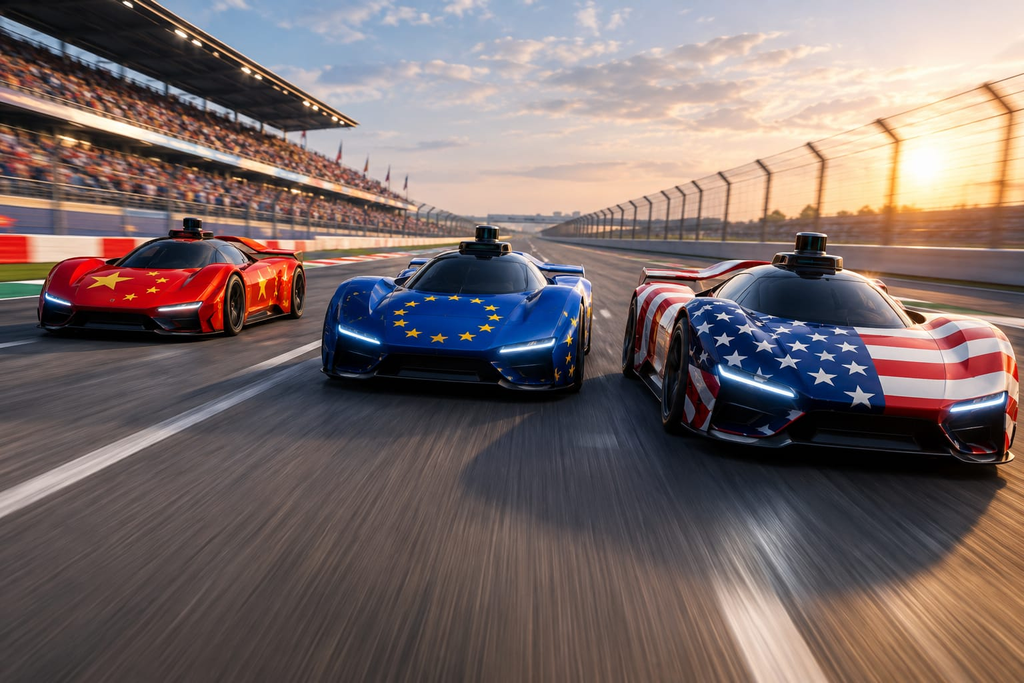
This is likely to lead to separate technological development between China (+Asia) and the US, with Europe – according to the McKinsey survey – expected by 35 per cent of respondents to share technologies with the US, by 12 per cent to share them with China, and by 26 per cent to develop its own independent technologies.
Difficulties and delays
As we have seen, the technology is very promising and at an advanced stage of development. But what is still needed for it to be adopted on a mass scale?
Luiss states that there are unresolved issues regarding regulations, both in terms of traffic and liability in the event of an accident, which will inevitably require political intervention; insurance companies are still unsure what insurance packages to offer, given that the risks and who bears liability (driver, manufacturer, component supplier) are not yet clearly defined.
In its survey, McKinsey adds to the above by expressing serious concerns about the very high development costs associated with this technology.
We should also bear in mind that there is a cultural issue at play, leading to different reactions to deaths caused by human error and those resulting from autonomous driving.
It’s easy to illustrate this. Consider this front-page headline: ‘3,000 deaths a year on our roads due to human error’ – it’s an annual occurrence, causing no scandal, no uproar; now consider this: “300 deaths a year on the roads caused by autonomous driving” – how many calls to halt the whole programme, parliamentary questions and debates about ‘killer technology’ would there be? I dare not imagine, and yet we would be talking about a 90 per cent reduction in deaths.
I’ll conclude with a statement (here 19) from the CEO of Niulinx regarding the new Highway Code (which, at the time of writing, had not yet been approved): “This text needs to be amended; otherwise, it will be impossible to provide a service in our country.”
Sources
2: https://informatecdigital.com/it/Robotaxi%3A-il-futuro-della-mobilit%C3%A0-autonoma/
3 https://www.iea.org/reports/autonomous-vehicles
4 https://elettricomagazine.it/emobility/guida-autonoma-lo-sviluppo-trainato-dallai/
6.https://www.merbag.ch/it/autovetture/servizio-consulenza/lessico-tecnico/mercedes-benz-drive-pilot/
7 https://waymo.com/safety/impact/
8 https://www.iihs.org/api/datastoredocument/bibliography/2374
10: https://www.vadoetornoweb.com/guida-autonoma-daimler-truck-torc/
11:https://www.futuroprossimo.it/2026/08/cina-il-camion-autonomo-di-livello-4-e-merce-che-viaggia-da-sola/
12:https://www.rinnovabili.it/mobilita/logistica/battery-swap-catl-il-colosso-cinese-punta-sui-mezzi-pesanti/
13:https://www.hdmotori.it/camion-guida-autonoma-senza-cabina-einride-lidl/
15: https://www.wired.it/article/come-la-cina-vuole-dominare-anche-il-mercato-dei-robotaxi/