Macron fortifies France against the Russian hybrid threat
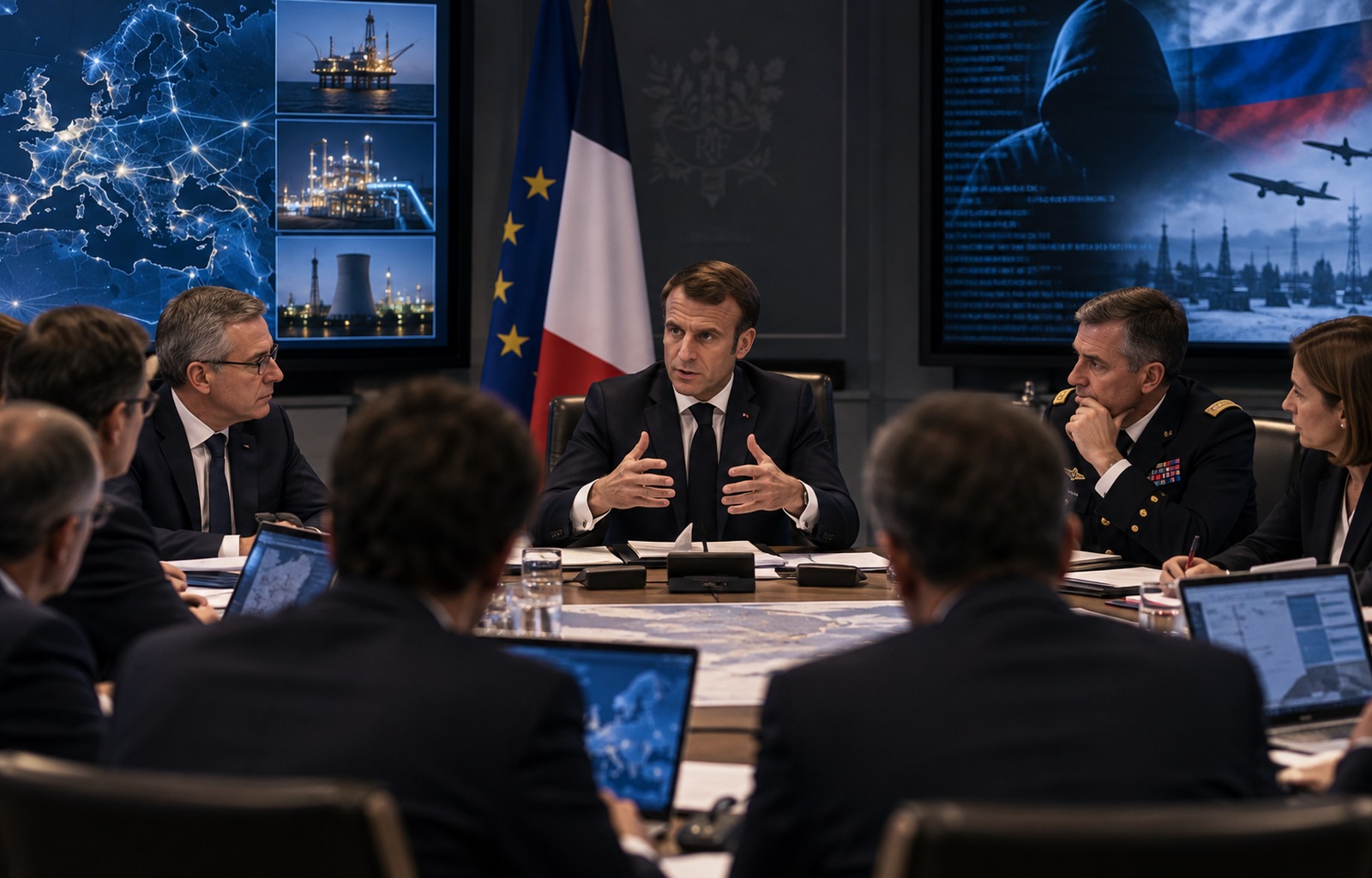
Emergency summit in the basement of the Élysée Palace. Faced with the rapidly escalating crises in the Middle East and Ukraine, President Macron has convened leaders from across the political spectrum to share intelligence and propose a plan to protect energy infrastructure against the Russian hybrid threat.
The summit at the Élysée Palace
On 18 September, President Emmanuel Macron summoned the leaders of the parties represented in Parliament – or the candidates for the 2027 presidential election – to the Élysée Palace, together with Prime Minister Sébastien Lecornu and the heads of the intelligence and defence services, reviving the so-called Saint-Denis format, the cross-party consultation process launched by Macron in 2023.
The meeting, which took place in the Vega Room – the Élysée Palace bunker normally reserved for Defence Council meetings – had been convened to take stock of the “rapid deterioration of the international situation” linked to the conflicts in Ukraine and the Middle East and their implications for security and energy in France.
At the end of the meeting, which lasted around three hours, Macron announced the most concrete decision to emerge from the summit: ‘The nature of Russian aggression and the threats in Europe is changing.’
The President announced that he had asked the government to draw up a plan to protect critical infrastructure — including the most sensitive sites within the defence industry and technology sector — against drone attacks and cyber threats, referring to an “intensified” Russian hybrid threat against Europeans and France, and reiterating that support for Ukraine remains “a prerequisite for our security and a return to lasting peace”.
Firmness without escalation
On the diplomatic front, according to Édouard Philippe ’s remarks as he left the meeting, Macron is said to have been “very clear on the need to continue sending messages to Russia”, whilst not wishing to “enter into hostilities” with Moscow — a line that confirms the firm but non-escalatory approach already taken to date.
In support of the warning about the hybrid threat, the President cited a series of recent incidents attributed to Moscow, including an attack on a train in Ukraine and a disturbance at Leipzig Airport, which were presented as evidence of the increasingly aggressive and diverse nature of Russian actions against Europe.
The energy front
On the energy front, Macron announced that France will convene a G7 meeting on energy, assuring that it is working to secure supplies of diesel and gas and to prevent market tensions.
Reactions: safety, yes, but the opposition is protesting over fuel prices
The political camp was immediately divided over priorities. Édouard Philippe, on leaving the meeting, confirmed that “the threat level” is rising due to the conflict in Ukraine. Marine Tondelier (Écologistes) echoed this sentiment, citing serious grounds for concern regarding Russia’s “destabilisation efforts”.
The issue of purchasing power proved far more contentious. Jordan Bardella complained that the fuel issue had not been adequately addressed, claiming that the government had ‘brushed it aside’ during the meeting, and called on Macron to agree to a reduction in fuel taxes.
Fabien Roussel (PCF) took a similar line, arguing that the President does not envisage “any short-term solution” to the issue of prices. Raphaël Glucksmann, for his part, said he had called for “more substantial” aid for citizens.
The context: a week of diplomacy, with threats looming in the background
Seated at the summit table, alongside Prime Minister Lecornu and the Speakers of the Chambers, Yaël Braun-Pivet and Gérard Larcher, were Bruno Retailleau, Gabriel Attal, Raphaël Glucksmann, Edouard Philippe, Olivier Faure, Marine Tondelier, Fabien Roussel and Eric Ciotti, as well as delegates representing Marine Le Pen (Jordan Bardella) and Jean-Luc Mélenchon (Manuel Bompard).
Also present were senior officials from the DGSI (Direction Générale de la Sécurité Intérieure, the domestic intelligence agency), the DGSE (Direction Générale de la Sécurité Extérieure, foreign intelligence), the SGDSN (Secrétariat général de la défense et de la sécurité nationale, the body responsible for coordinating defence and national security under the Prime Minister) and the DRM (Direction du Renseignement Militaire, military intelligence), as well as the Director-General for Energy.
The summit comes at the height of a week of intense diplomatic activity by the Élysée Palace focusing on the Gulf and the Levant: contacts with the Iraqi Prime Minister, the Saudi Crown Prince and the Emir of Qatar, and — on the eve of the summit, Thursday 17 September — a meeting in Paris with the King of Jordan and the President of Lebanon.
The energy crisis and foreign interference
In the background lies the energy crisis linked to tensions in the Strait of Hormuz, through which around 20 per cent of the world’s oil and LNG passes: Brent crude exceeded $85 a barrel in mid-July, with some analysts not ruling out a further rise towards $100.
Added to this is the issue of foreign interference: Viginum, the French agency tasked with combating interference, has already documented four instances of digital interference during last March’s local elections, warning that the risk could intensify in the run-up to the 2027 presidential elections.
On the domestic front, the summit takes place against a backdrop of very low presidential approval ratings, with Macron — who is constitutionally barred from standing for re-election — having chosen to share the confidential information in his possession with the opposition, in the spirit of collective responsibility towards those who aspire to govern the country after him.